IMPORTANT
The Next Nvidia: 7 AI Stocks, The information provided in this document is strictly for educational and informational purposes and constitutes “Your Money or Your Life” (YMYL) content. It does not constitute financial, investment, legal, or tax advice. The “New Magnificent 7” framework, associated price targets, and market analyses are based on specific research methodologies and should not be interpreted as a guarantee of future performance. Investing in the stock market, particularly in high-growth sectors like Artificial Intelligence (AI) and semiconductors, involves significant risk, including the potential loss of principal.
Before making any investment decisions, you must consult with a certified financial professional or a registered investment advisor to ensure any strategy aligns with your specific risk tolerance and financial goals. The author, acting as a Senior Equity Research Analyst, and the source material provider are not acting as your personal financial advisors. All data, including price targets, forward P/E ratios, and revenue projections, are based on current market conditions and are subject to change without notice. Past performance is never indicative of future results.
The Next Nvidia: 7 AI Stocks
INTRODUCTION
The Next Nvidia: 7 AI Stocks, the global economy is currently navigating a generational inflection point that rivals—and likely exceeds—the invention of the personal computer, the birth of the internet, and the smartphone revolution. This shift is driven by Generative Artificial Intelligence (AI), a general-purpose technology that is fundamentally re-architecting the infrastructure of modern civilization. From computational biology and gene editing to autonomous transportation and the supercomputers that facilitate them, the AI era is no longer a speculative future—it is a multi-trillion dollar reality unfolding in real-time.
For the modern investor, however, this transition presents a profound dilemma. Having witnessed Nvidia’s meteoric rise to market dominance, many retail and institutional players feel they have “missed the boat.” The difficulty lies in identifying high-growth assets before they achieve mainstream “Magnificent 7” status and suffer from valuation bloat. The question on every trading desk is simple: What is the “Next Nvidia”?
This report outlines the “New Magnificent 7” framework. This is not merely a list of trending tickers; it is a sophisticated investment thesis designed to capture the entire value chain of the AI era. By synthesizing technical moats with institutional capital flows, we have identified seven companies positioned to dominate the 2026 AI revolution and beyond. Our strategy moves away from speculative “AI-themed” plays and focuses on the companies that own the “racecourse” of the future.
The Next Nvidia: 7 AI Stocks
MACRO ANALYSIS: THE EVOLUTION OF THE AI TECH CYCLE
To project where the market is headed in 2026, we must first understand the structural anatomy of tech cycles. According to a landmark case study by Morgan Stanley Research, general-purpose technologies like wireless internet or generative AI often take a decade or more to achieve mass-market adoption. We are currently in the “early innings” of the AI cycle, which we anticipate will follow a predictable three-part evolution:
- Semiconductors: The “Golden Age” of hardware, where the chips required to process and train LLMs (Large Language Models) see explosive demand.
- Infrastructure: The construction of massive data centers and the development of hardware/software platforms that facilitate AI workloads at scale.
- Software/Agents: The high-margin layer where digital and physical agents—powered by the underlying infrastructure—provide direct services to end-users.
The Institutional Pivot: From Defense to Aggression
In previous cycles, established giants like Google and Apple often maintained leadership by playing a “defensive” game—protecting existing moats (like search or hardware ecosystems). However, the AI era has forced an institutional shift. Leading firms are now engaged in “aggressive infrastructure building.” We are seeing capital expenditure (CapEx) reach unprecedented levels, with companies like Microsoft and Meta Platforms investing tens of billions of dollars annually to secure their place in the AI foundation.
The “Circle of Competence” and Economic Drivers
From my perspective as an analyst with a background in electrical engineering and data science, the economic drivers of this cycle are concentrated in technical superiority rather than mere brand recognition. The core bottleneck remains the manufacturing of advanced chips—a market where one player holds a 90% share—and the physical scaling of data centers, where annual investments are now exceeding $80 billion for the top-tier players.
To “get rich without getting lucky,” investors must operate within a strict circle of competence, focusing on “parallel computing” and high-performance computing (HPC) rather than companies that are simply adding an AI chatbot to an aging software stack.
The Next Nvidia: 7 AI Stocks
CASE STUDY: NVIDIA (THE GOLD STANDARD)
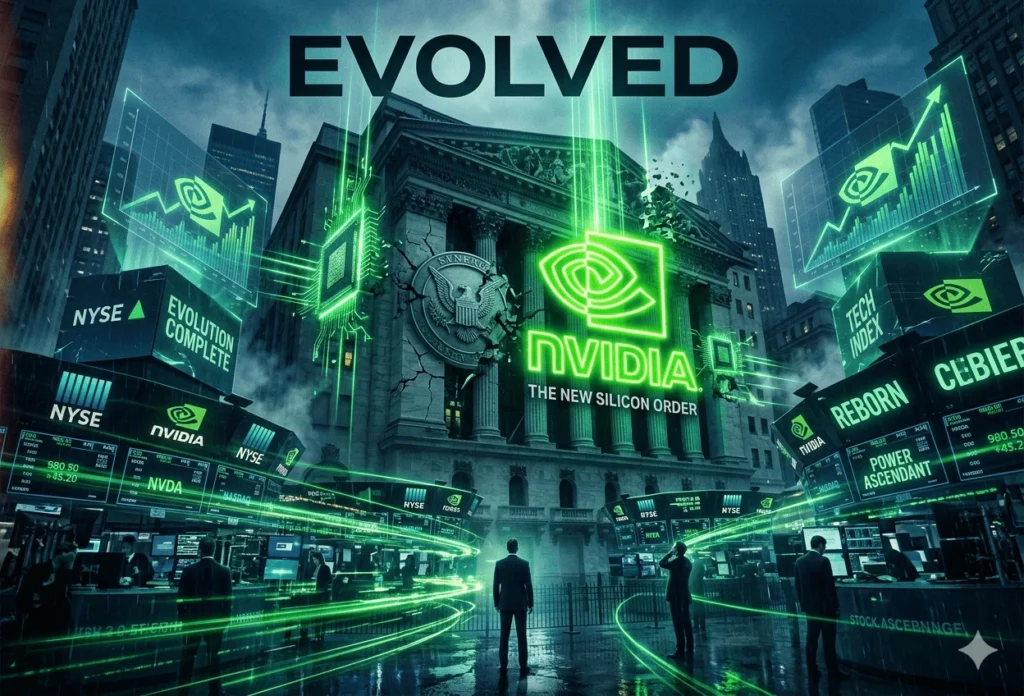
Nvidia serves as the literal foundation of the generative AI revolution and remains the benchmark for our “New Magnificent 7” framework.
Technical Moat and Ecosystem Dominance
Nvidia’s dominance is not predicated solely on manufacturing chips; it is secured by a proprietary ecosystem that competitors have struggled to replicate for two decades. The key is CUDA (Compute Unified Device Architecture), which has been the industry standard for GPU programming since 2006. While traditional CPUs handle tasks sequentially, Nvidia’s GPUs enable parallel computing, accelerating slow codebases by up to 100 times. This is essential for ray tracing, fluid dynamics, and the deep learning required for AI training.
Beyond the chip level, Nvidia’s infrastructure includes:
- NVLink Switches: High-speed chip-to-chip connections.
- Spectrum X Ethernet: Purpose-built networking for AI data centers.
- NVLink Fusion: A critical integration layer that allows Nvidia hardware to work with third-party accelerators, including those from Google and Microsoft.
Future Roadmap and Catalysts
Nvidia’s aggressive release cycle prevents competitors from closing the performance gap. The roadmap through the end of the decade is clear:
- 2024-2025: Blackwell and Blackwell Ultra architectures.
- 2026: The “Reuben” GPU platform.
- 2027: Reuben Ultra.
- 2028: The “Fineman” architecture.
Financial Performance: Nvidia (NVDA)
| Metric | Target / Current Value |
| Price Target | $24.00 (Projected/Split-Adjusted Basis) |
| Market Cap Target | $5.0 Trillion |
| Data Center Revenue | $39 Billion (Quarterly) |
| Revenue Growth | 73% Year-over-Year |
| Segment Focus | AI Infrastructure & Parallel Computing |
Analyst Note: The $24.00 price target is derived from the source’s projection of a $5 trillion market cap, representing roughly 33% upside from previous valuation benchmarks.
The Next Nvidia: 7 AI Stocks
CORE INVESTMENT STRATEGY: THE NEW MAGNIFICENT 7
The objective is to “own the entire racecourse.” This strategy identifies the winners across three distinct layers: Foundations, Infrastructure, and Agents.
THE FOUNDATION LAYER
These are the “hyperscalers” providing the compute and storage required for the AI era.
1. Microsoft (MSFT)
Microsoft operates what is arguably the most comprehensive AI platform on the planet.
- CapEx Intensity: Microsoft is investing $80 billion into data centers this year alone to support AI workloads and upgrade their proprietary Azure Maya AI accelerators.
- Moat: Their Azure AI Foundry supports nearly 2,000 AI models, creating a “one-stop-shop” for enterprise AI deployment.
- Revenue Impact: AI services are already contributing $13 billion to annual revenue, growing at a staggering 175% year-over-year.
2. Amazon (AMZN)
Amazon Web Services (AWS) powers over 30% of the internet. Their scale allows them to be the only serious internal competitor to Nvidia for specific workloads.
- Custom Silicon: Amazon’s Tranium 2 chips are 33% more efficient than standard GPUs for specific training tasks, providing a significant cost advantage for their cloud customers.
- Strategic Investment: Their $8 billion investment in Anthropic (20% stake) ensures they remain at the cutting edge of foundation model development.
THE INFRASTRUCTURE LAYER
The manufacturers and software architects who build the tools the rest of the world uses.
3. Taiwan Semiconductor Manufacturing Company (TSM)
TSMC is the ultimate bottleneck of the AI industry.
- Market Dominance: They produce over 90% of the world’s advanced AI chips, including those for Nvidia, Apple, and Broadcom.
- Financial Strength: High-performance computing (HPC) accounts for 50% of revenue, and the company maintains 50% gross margins.
- Valuation: With a $300 price target, we project a $1.3 trillion valuation as the world realizes there is no AI without TSM.
4. Broadcom (AVGO)
Broadcom is Nvidia’s biggest competitor—not AMD. Their focus is on the networking fabric of the data center.
- XPU & Networking: Their XPU handles large-scale inference at low power, and their Tomahawk 6 switch can support clusters of over 100,000 chips.
- Software Layer: The acquisition of VMware allows for “resource pooling,” where companies can run resource-hungry AI workloads across multiple servers efficiently.
- Verdict: Broadcom is currently roughly 15% overvalued (Fair Value: $235), making it a prime candidate for dollar-cost averaging.
5. Palantir (PLTR)
The only pure-play software company in our infrastructure group.
- AIP Platform: Palantir’s Artificial Intelligence Platform (AIP) allows highly regulated industries (defense, healthcare) to build AI agents without technical expertise.
- Growth: Revenue is growing at 40% per year.
- Risk Warning: Currently trading at a 400 forward P/E, Palantir is technically overvalued today. However, we expect it to grow into its $350 billion valuation over the next five years.
THE AGENT LAYER
The interface between AI and the end-user.
6. Meta Platforms (META)
Meta has transitioned from a social media company to an “Agent Leader.”
- Scale: Meta AI is nearing 1 billion monthly active users.
- Strategic Data Acquisition: Meta recently invested $14.3 billion for a 49% stake in Scale AI, integrating advanced data labeling directly into their training pipeline.
- Open Source: The Llama model family has become the industry standard for open-source AI, ensuring Meta remains the primary architect of the AI-infused user experience.
ETF & Strategic Investment Vehicles
| Vehicle Category | Strategic Advantage | Analyst Pro Tip |
| Foundation Fund | Owning the cloud “landlords” (MSFT, AMZN). | Focus on companies where cloud revenue growth exceeds 20%. |
| Hardware Dominance | Owning the “Bottleneck” (TSMC, AVGO). | Mitigate geopolitical risk in TSMC via slow, periodic accumulation. |
| Software Agent Play | Capturing high-margin end-user interaction (Meta, PLTR). | Exercise patience with Palantir; wait for valuation compression. |
| Semiconductor Core | Pure exposure to GPU and ASIC production (NVDA). | Watch the transition from Blackwell to Reuben as the 2026 catalyst. |
| Data Center Infra | Physical scaling of the AI world. | Prioritize firms with high “Operating Leverage” and large CapEx. |
The Next Nvidia: 7 AI Stocks
10 MARKET GIANTS DRIVING THE INDEX
The transition to the AI era has forced a reshuffling of the market’s elite. Below is the “Analyst Verdict” on the 10 giants driving the current index, including the three “Exited Giants” that no longer meet our criteria for the New Magnificent 7.
The New Magnificent 7
- Nvidia: The indispensable hardware layer. Verdict: Unbeatable moat via CUDA.
- Microsoft: The enterprise AI standard. Verdict: The safest play for institutional adoption.
- Amazon: The custom silicon powerhouse. Verdict: Dominant cloud scale with internal chip efficiency.
- Meta Platforms: The agent and open-source leader. Verdict: Best-in-class user reach and high-margin advertising.
- TSMC: The manufacturer of the future. Verdict: The single point of failure and success for the industry.
- Broadcom: The networking specialist. Verdict: Strongest competitor to Nvidia in infrastructure networking.
- Palantir: The AI software operating system. Verdict: Essential for mission-critical and regulated AI execution.
The 3 Exited Giants (Removed from the List)
- Apple: Analyst Verdict: Removed due to a lack of OS-level execution for AI agents. Despite having the best customer data set (health, payments, schedule), Apple has failed to leverage it for a proactive AI assistant.
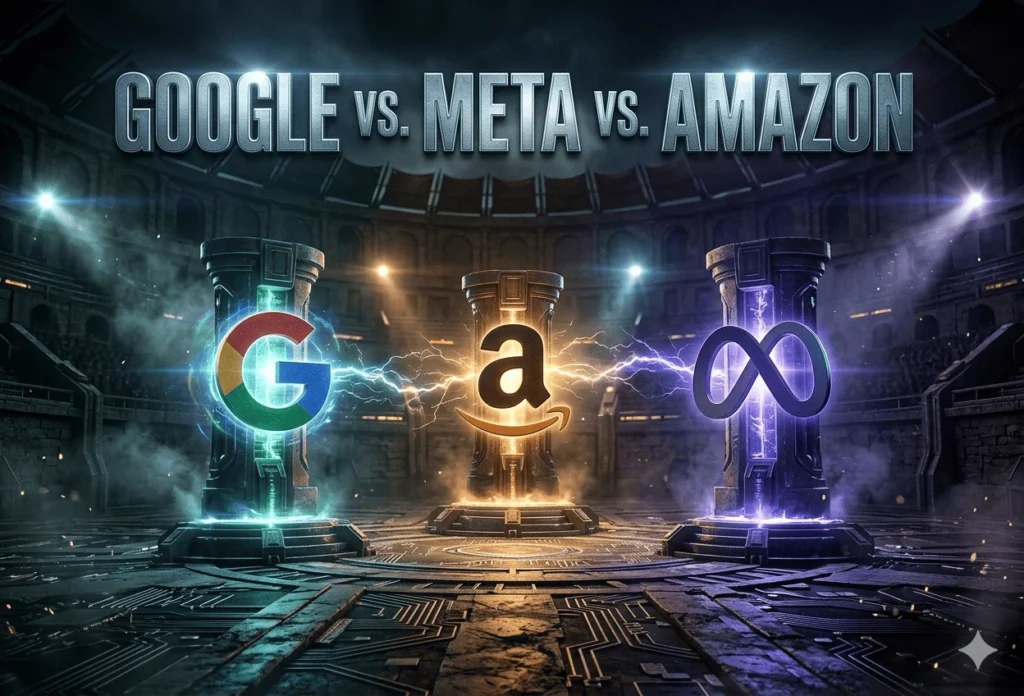
- Google: Analyst Verdict: Removed for “playing defense.” Google has spent the last two years responding to innovations from OpenAI and Microsoft rather than leading. While profitable, they are no longer the aggressive vanguard of the tech cycle.
- Tesla: Analyst Verdict: Removed due to extreme technical and business risks. Tesla’s operating margins fell to a razor-thin 2.1% in Q1. Furthermore, their “vision-only” approach to FSD lacks the sensor redundancy (radar/Lidar) that regulators likely require for Level 5 autonomy.
FAQ: INVESTING IN THE AI REVOLUTION
1. What defines the “Next Nvidia”? It is not one stock, but the “New Magnificent 7” group that provides the foundations (MSFT, AMZN), the infrastructure (TSMC, AVGO, PLTR), and the agents (META). These companies own the “racecourse” upon which all AI progress must run.
2. Why is TSMC considered the most critical stock in the world? TSMC manufactures 90% of the world’s advanced AI chips. Without TSMC, there is no Nvidia Blackwell, no Broadcom XPU, and no Apple Intelligence. They are the ultimate hardware bottleneck.
3. What is the difference between digital and physical agents? Digital agents, like Microsoft’s Copilot, automate software tasks (coding, emails). Physical agents, like Waymo’s autonomous cars, interact with the real world. Both represent the high-margin “third layer” of the AI cycle.
4. Is Palantir’s 400 forward P/E a deal-breaker for investors? It is a signal for caution, not necessarily a reason to sell. With 40% annual revenue growth, Palantir is expected to “grow into” its valuation over a 5-to-10-year horizon. We recommend dollar-cost averaging.
5. What are the specific risks that removed Tesla from the list? Technical risk (vision-only FSD), regulatory risk (lack of sensor redundancy), keyman risk (Elon Musk’s divided attention), and business risk (71% drop in net income and declining margins).
6. How does Broadcom compete with Nvidia if they don’t make GPUs? Broadcom dominates the “networking” side of AI. Their Tomahawk switches and custom ASICs (XPUs) are vital for connecting thousands of chips together, which is just as important as the chips themselves.
7. How long will the AI investment cycle last? History suggests mass market adoption takes 10+ years. We are currently in the infrastructure phase; the software agent explosion is likely a 2026-2030 event.
8. What is “Resource Pooling” in the context of Broadcom/VMware? It is the ability to combine the power of multiple servers into a single “virtual machine.” This is critical for running massive AI models that are too large for any single physical server to handle.
9. Can Amazon really compete with Nvidia in chips? Yes, but only for specific internal workloads. Amazon’s Tranium 2 chips are designed to train models more cheaply within the AWS ecosystem, reducing their reliance on expensive third-party GPUs.
10. What is the “Analyst Pro Tip” for retail investors? Operate within your “circle of competence.” If you don’t understand how parallel computing or data center networking works, stick to the large-cap leaders (MSFT, NVDA) and use dollar-cost averaging to manage volatility.
CONCLUSION: THE SHIFT TO THE AI ECONOMY
The transition from the mobile era to the AI era is the defining economic event of the 2020s. Success in the markets over the next five years will require a move away from the “Magnificent 7” of the past and a disciplined focus on the three layers of the AI stack: Foundations, Infrastructure, and Agents.
By investing in high-conviction, high-moat companies—the New Magnificent 7—investors can capitalize on the massive data center build-outs and the subsequent software revolution. This strategy is built on the philosophy of “getting rich without getting lucky.” It is about owning the companies that make the revolution possible, maintaining the discipline to weather valuation swings, and compounding wealth through the most significant technological shift in human history.
The Next Nvidia: 7 AI Stocks
FINAL DISCLAIMER
FOR EDUCATIONAL PURPOSES ONLY.
This research report is provided by Alex (Ticker Symbol: YOU) for informational and educational purposes only. Past performance does not guarantee future results. Stock market investments are inherently risky and subject to market volatility. Always conduct your own due diligence and consult with a certified financial professional before allocating capital to any of the assets mentioned in this report. The author does not guarantee the accuracy or completeness of the data provided herein.








![Truths About Neptune Insurance That Nobody Tells You [2026]](https://brayzor.com/wp-content/uploads/2026/03/Truths-About-Neptune-Insurance-That-Nobody-Tells-You-2026-1-300x204.webp)











































![Truths About Neptune Insurance That Nobody Tells You [2026]](https://brayzor.com/wp-content/uploads/2026/03/Truths-About-Neptune-Insurance-That-Nobody-Tells-You-2026-1-1024x696.webp)