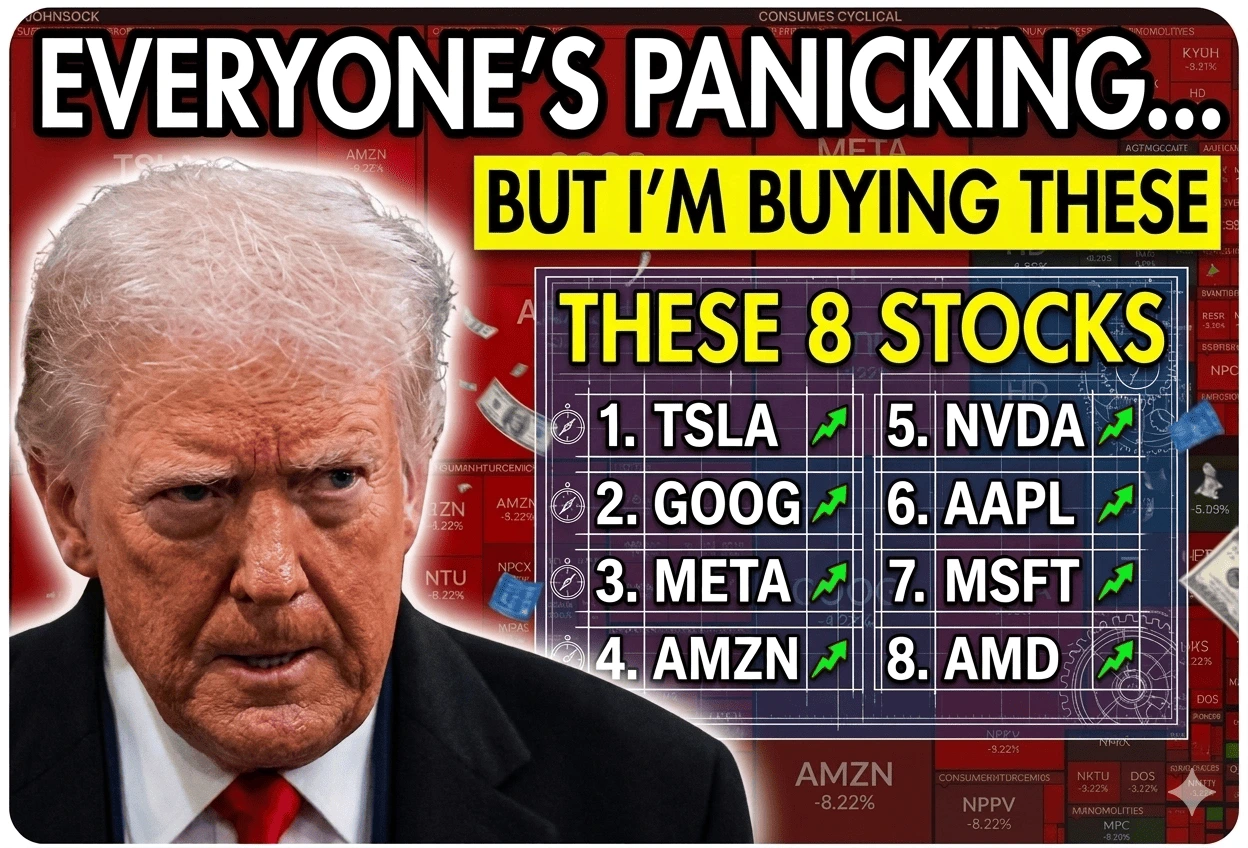
Everyone’s Panicking But I’m Buying These, as we enter the current trading window, market sentiment has reached a critical pivot point. With the S&P 500, Nasdaq, and Dow Jones all retracing into negative territory year-to-date, the “grace period”—the window where investors assumed geopolitical tensions would remain localized—has officially shuttered. Investor sentiment has plunged into “Extreme Fear” territory, with readings hovering in the mid-20s.
While the indices are only a few percentage points off their all-time highs, the underlying technicals suggest the market has not yet fully digested the systemic risks of a prolonged energy shock. However, as a senior analyst, I view this “blood in the streets” not as a signal to retreat, but as the mechanism that widens the gap between a company’s market price and its intrinsic value.
Everyone’s Panicking But I’m Buying These
Macro Analysis: The $120 Oil Threat and Global Multiples
The primary catalyst for the current volatility is the resurgence of energy as a “tax on the global economy.” Crude oil has breached the $100 mark, with early sessions seeing prices approach $120. When energy costs spike, companies face immediate margin compression via input costs, while consumers experience a sharp contraction in discretionary spending.
The supply-side fragility is centered on the Strait of Hormuz, a vital artery for 20% of the world’s seaborne oil and fuel products. The market is currently pricing in a high probability of disruption in this corridor. This risk is compounded by significant production cuts, most notably in Iraq (currently shutting in 3 million barrels per day), alongside anticipated reductions in Kuwait and Saudi Arabia. While a coordinated G7 strategic reserve release remains a possibility, the short-term reality is one of supply-side shock.
The Valuation Lens: Margin of Safety in a High-Cost Environment
In a volatile market, our methodology shifts from momentum to a rigorous “Margin of Safety” framework. We utilize three primary filters:
- PEG Ratio Analysis: Identifying companies where growth is being priced at a significant discount to historical sector averages.
- Discounted Cash Flow (DCF): Establishing an absolute intrinsic value.
- Reverse DCF: Calculating the “Implied Growth Rate”—what the market is actually pricing in—to identify cases of extreme market pessimism.
Everyone’s Panicking But I’m Buying These
Tier 1: High-Conviction Compounders (The Elite Core)
These are “wide-moat” businesses where the business model provides a natural hedge against macro instability.
Microsoft (MSFT)
- Analysis: Microsoft remains the backbone of enterprise infrastructure. Its high switching costs and the massive tailwind of Azure and AI integration make it a mandatory holding.
- Valuation: Trading at 23x forward earnings, a sharp contraction from its 5-year average of 31x.
- Growth Drivers: Cloud dominance, AI ecosystem monetization, and exceptional net margins of 39%.
- Targeting: Intrinsic Value indicates a 16% Margin of Safety, while the Wall Street consensus price target of $595 implies 47% upside.
Mastercard (MA)
- Analysis: A “toll-booth” model that captures fees without the lending risk of traditional banks. It is a direct beneficiary of the global transition to digital payments.
- Valuation: Trading at 26.5x forward earnings against a historical 32x.
- Growth Drivers: Scalable network effects and a massive runway in emerging markets.
- Targeting: Model-derived Intrinsic Value of $672, representing a 23% Margin of Safety.
S&P Global (SPGI)
- Analysis: Essential financial infrastructure. With operating margins exceeding 40%, it is a dominant provider of credit ratings and data analytics.
- Reverse DCF Signal: The market is currently pricing in only 6.9% growth, which is significantly lower than its 5-year and 10-year CAGRs.
- Targeting: Intrinsic Value of $550 vs. a current price of approximately $435, providing a 21% Margin of Safety.
Meta Platforms (META)
- Analysis: Meta has successfully pivoted into an AI-driven advertising powerhouse. Revenue growth of 22% continues to outpace the industry average.
- Growth Drivers: AI-enhanced ad targeting efficiency and long-term optionality in immersive computing (Metaverse).
- Targeting: Intrinsic Value of $743, offering a 15% Margin of Safety.
Everyone’s Panicking But I’m Buying These
Tier 2: Attractive Opportunities with Cyclicality
These companies offer high-quality fundamentals but are more sensitive to capital market cycles.
KKR & Co. (KKR)
- Analysis: As institutional capital shifts toward alternatives (Private Equity, Credit, Real Estate), KKR acts as a primary gatekeeper.
- The Insider Signal: We have seen massive conviction from the C-suite. Senior executives Kusuo, Scott, Joseph, and Mary have collectively purchased over $15 million in shares on the open market recently.
- Targeting: Trading at 13–14x forward earnings (vs. 18x average). Intrinsic Value of $116 provides a 24% Margin of Safety.
Elevance Health (ELV)
- Analysis: A defensive powerhouse. Healthcare demand is non-discretionary, providing a hedge against an oil-induced slowdown.
- Reverse DCF Signal: The market is pricing in a mere 1.3% long-term growth for the 2nd largest health insurer in the US—a staggeringly conservative assumption given an aging population.
- Valuation: The 2.5% dividend yield is currently double the 5-year average of 1.25%.
- Targeting: Intrinsic Value of $327, offering a 15% Margin of Safety.
Everyone’s Panicking But I’m Buying These
Tier 3: High-Risk, High-Upside Growth
For the risk-tolerant investor, these names offer the most significant valuation disconnects.
SoFi Technologies (SOFI)
- Analysis: SoFi is not a bank; it is a digital financial ecosystem. It currently carries an “A+ growth grade” with revenue expansion of 30-35%.
- Reverse DCF Signal: Despite 30% top-line growth, the market is only pricing in 7.6% long-term growth.
- Insider Signal: CEO Anthony Noto recently purchased 56,000 shares on the open market.
- Targeting: Intrinsic Value of $27, providing a 35% Margin of Safety.
Uber (UBER)
- Analysis: Uber has transitioned into a profitable platform business with 78% EBIT growth. It is effectively becoming the “operating system for autonomous transportation networks.”
- Valuation: Its PEG ratio is 47% cheaper than the sector overall.
- Targeting: Our model yields an Intrinsic Value of $150, implying a massive 50% Margin of Safety.
Everyone’s Panicking… But I’m Buying These
Summary of Conviction: The Investor’s Tier List
| Stock | Tier | Primary Appeal | Margin of Safety |
| Microsoft (MSFT) | Tier 1 | AI Leadership & Enterprise Cloud | 16% |
| Mastercard (MA) | Tier 1 | Scalable Network; No Credit Risk | 23% |
| S&P Global (SPGI) | Tier 1 | Essential Financial Infrastructure | 21% |
| Meta Platforms (META) | Tier 1 | Ad Dominance & AI Integration | 15% |
| KKR & Co. (KKR) | Tier 2 | Alternative Asset Management Growth | 24% |
| Elevance Health (ELV) | Tier 2 | Defensive Cash Flow; Yield Play | 15% |
| SoFi (SOFI) | Tier 3 | Hyper-Growth Fintech Ecosystem | 35% |
| Uber (UBER) | Tier 3 | Platform Operating Leverage | 50% |
Everyone’s Panicking But I’m Buying These
Analytical FAQ
1. Why is the market retracing now? A confluence of $100+ oil, production cuts in Iraq, and the “End of the Grace Period” regarding Middle East stability. The market is re-pricing the risk of global margin compression.
2. What is the impact of $120 oil on my portfolio? It acts as a macro drag. Energy-intensive sectors face higher input costs, while consumer-facing companies see a drop in “wallet share.”
3. Is the S&P 500 overvalued? On an index level, the S&P remains near historical highs. However, individual “pockets of value” exist where PEG ratios and DCF models suggest significant underpricing.
4. Why does the Strait of Hormuz matter? It processes 20% of global seaborne oil. Closure or disruption is a “black swan” event for global energy supply.
5. Are there “buy signals” in this volatility? Yes. When high-quality compounders like Mastercard trade below their 5-year average P/E multiples, it historically marks an optimal entry point.
6. Is insider buying a reliable signal? For KKR and SoFi, it is highly significant. Multiple executives (Kusuo, Scott, Joseph, Mary at KKR) buying with personal capital suggests a disconnect between the stock price and internal growth projections.
7. Is Microsoft a buy at 23x earnings? Relative to a 31x historical average and its 47% operating margins, 23x represents a meaningful valuation contraction for a market leader.
8. How does KKR perform in a downturn? While deal activity can slow, the structural shift to alternative assets is a multi-decade trend. KKR’s current multiple suggests the market is overestimating the cyclical risk.
9. Why Elevance Health for defensive play? With a Reverse DCF pricing in only 1.3% growth, the market is essentially ignoring the structural demand of an aging population.
10. What does “Margin of Safety” mean in this economy? It is your protection against multiple compression. For instance, Uber’s 50% Margin of Safety means the stock is trading at half of its intrinsic value, providing a massive buffer if market conditions deteriorate further.
Everyone’s Panicking But I’m Buying These
Conclusion: The Power of Perspective
Market volatility is the mechanism by which the impatient transfer wealth to the disciplined. While the noise surrounding oil prices and geopolitical tensions is significant, the fundamental earnings power of the companies listed above remains robust. By focusing on wide-moat compounders with a verified Margin of Safety, you can look beyond the short-term panic and position yourself for the inevitable recovery. The data, not the headlines, should dictate your next move.As we enter the current trading window, market sentiment has reached a critical pivot point. With the S&P 500, Nasdaq, and Dow Jones all retracing into negative territory year-to-date, the “grace period”—the window where investors assumed geopolitical tensions would remain localized—has officially shuttered. Investor sentiment has plunged into “Extreme Fear” territory, with readings hovering in the mid-20s.
While the indices are only a few percentage points off their all-time highs, the underlying technicals suggest the market has not yet fully digested the systemic risks of a prolonged energy shock. However, as a senior analyst, I view this “blood in the streets” not as a signal to retreat, but as the mechanism that widens the gap between a company’s market price and its intrinsic value.