Tesla Stock Prediction this equity research report is provided for educational and informational purposes only and does not constitute financial, investment, legal, or tax advice. The analysis herein is based on market data and analyst projections available as of mid-February 2026. Investing in high-growth equities, particularly within the volatile technology and automotive sectors, involves substantial risk and the potential for total loss of capital.
You must consult with a licensed financial professional or investment advisor to assess your specific financial situation and risk tolerance before executing any trades or investment strategies. Neither the author nor the publisher assumes liability for any financial losses or damages resulting from the use of this information.
Navigating the Structural Re-valuation: Autonomous Disruption vs. Institutional Volatility
Tesla Stock Prediction
Introduction
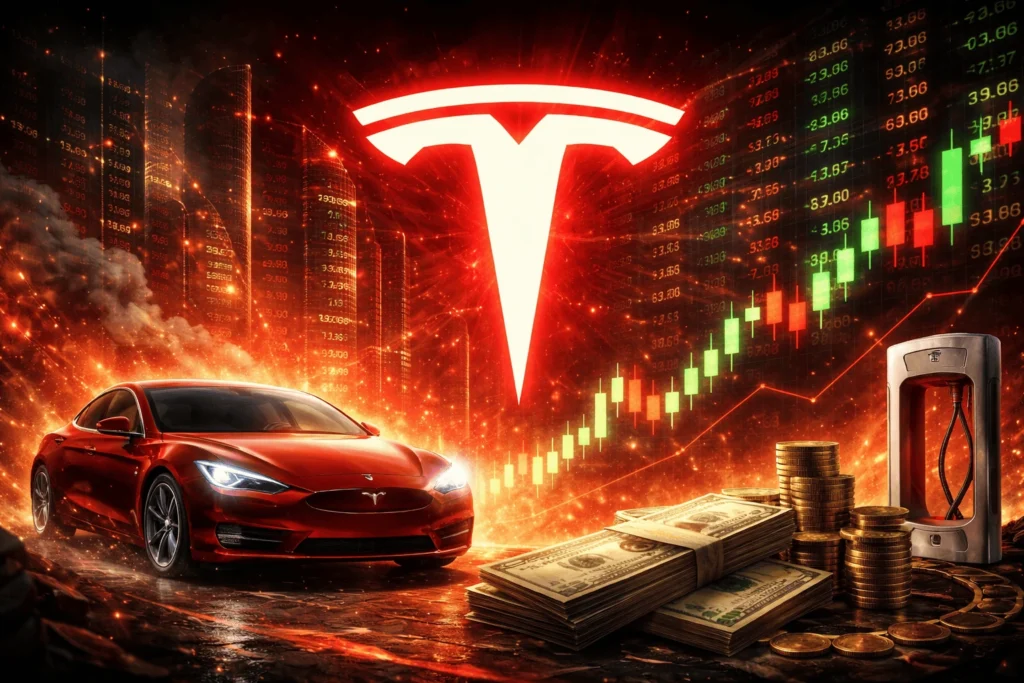
The equity markets are currently undergoing a structural re-valuation of Tesla (TSLA) shares. As of mid-February 2026, the primary challenge for institutional and retail investors alike is the transition of the valuation model from a unit-delivery automotive framework to a “Physical AI” enterprise value. This shift marks a pivotal moment where Tesla’s market capitalization is increasingly decoupled from quarterly vehicle delivery counts—which saw a 16% year-on-year decline in Q4 2025—and is instead tied to the execution of Full Self-Driving (FSD), the scaling of the Robotaxi network, and the commercialization of the Optimus humanoid robot.
The core investment thesis derived from current market conditions suggests that Tesla is no longer a traditional EV manufacturer; it is an AI and robotics powerhouse. For investors to realize long-term compounding, they must look past the “America Party” volatility of 2025 and evaluate the company’s ability to dominate the autonomous ride-hailing and humanoid labor markets.
Tesla Stock Prediction
Macro Analysis: The Pivot to Physical AI and Geopolitical Volatility
The macroeconomic landscape for Tesla is characterized by a “shifting of the guard,” moving from a maturing core EV business to what Dan Ives of Wedbush Securities calls the “biggest growth chapter” in the company’s history. This transition is taking place amidst a commoditized global EV market where Chinese competitors, led by BYD, continue to drive margin compression.
Institutional sentiment is currently split between high-conviction bulls and cash-flow-conscious bears:
- The Bull Case (Ives/Jonas): Analysts at Wedbush and Morgan Stanley focus on the “accelerated AI path.” Adam Jonas has compared the current autonomous breakthrough to the invention of the steam engine, declaring that “autonomous cars are solved.”
- The Bear Case (Delaney/Goldman Sachs): Mark Delaney has raised concerns regarding Tesla’s $20B+ capital expenditure (CapEx) plan for 2026, which is heavily weighted toward AI training infrastructure. Goldman Sachs maintains a Neutral rating, citing expectations for negative free cash flow (FCF) through the current fiscal year.
Geopolitical and Governance Risks: The 2025-2026 period has been defined by extreme political volatility. Shares experienced a sharp 14% one-day drop in June 2025 following the public feud between Elon Musk and President Donald Trump regarding the “Big Beautiful Bill,” which proposed the elimination of EV tax credits. Furthermore, Musk’s involvement with the Department of Government Efficiency (DOGE) has introduced a “distraction premium,” as investors weigh his political activities against his leadership focus at Tesla.
Tesla Stock Prediction
Case Study: Tesla (TSLA) Deep Dive
Tesla is now positioned as a hybrid automaker and artificial intelligence firm. Key catalysts for the 2026–2030 horizon include the Robotaxi rollout across 30+ US cities and the production ramp of the dedicated “Cybercab.” Analyst TD Cowen highlights that Cybercab’s operating costs of ~$0.30 per mile are low enough to unlock massive growth in previously untapped rideshare markets.
Furthermore, the software-as-a-service (SaaS) layer of the business is maturing. Morgan Stanley values Tesla’s software, licensing, and charging suite at approximately $160 per share, underscoring the shift toward high-margin recurring revenue.
Tesla (TSLA) Key Financial Metrics & Projections
| Metric | Value/Detail |
| Current Price (Mid-Feb 2026) | ~$417 |
| All-Time High (Dec 2025) | $498.83 |
| Market Cap Projection (2026 Bull Case) | $2 Trillion to $3 Trillion |
| Capital Expenditure (2026) | Over $20 Billion (AI Training Focus) |
| Cybercab Operating Cost | ~$0.30 per mile |
| Analyst Sentiment | Outperform (Ives) / Neutral (Delaney) / Buy (Stifel/TD Cowen) |
| High Price Target | $600 (Dan Ives, Wedbush) |
Analyst Sentiment Synthesis: While Stifel notes that Q4 2025 revenue and gross profit exceeded expectations, the market remains fixated on the “Physical AI” timeline. Dan Ives maintains a $600 target, predicated on an “accelerated AI autonomous path.” Conversely, Mark Delaney (Goldman Sachs) lowered his target to $405, citing the FCF strain of the $20B CapEx.
Tesla Stock Prediction
Core Investment Strategy: The “Autonomy and Energy” Play
Investors seeking exposure to the Physical AI revolution should focus on five distinct strategic themes identified in the current market cycle:
- Autonomous Ride-Hailing Infrastructure:
- Focus: Robotaxi scaling and FSD licensing to third-party OEMs.
- Why it Matters: This shifts Tesla from a one-time hardware sale to a high-margin service model.
- Analyst Pro Tip: Monitor regulatory approvals in the seven new metro areas scheduled for H1 2026; any delay here will trigger a valuation pullback.
- Humanoid Robotics Supply Chain:
- Focus: Optimus V3 development and specialized actuator production.
- Why it Matters: With production slated for late 2026, Optimus represents a total addressable market (TAM) that could eventually exceed the automotive sector.
- Analyst Pro Tip: Watch for supply chain milestones specifically regarding the internal production of robotic components to gauge margin health.
- Renewable Energy Storage:
- Focus: Megapack utility-scale storage and solar integration.
- Why it Matters: The energy division is poised for “substantial growth,” acting as a revenue stabilizer against automotive volatility.
- Analyst Pro Tip: Evaluate the energy storage deployment figures as a leading indicator of Tesla’s ability to hedge against EV slowing.
- AI Training Infrastructure:
- Focus: Companies and compute resources supporting the $20B+ CapEx.
- Why it Matters: Tesla’s “camera-only” FSD approach requires massive neural network training, challenging the LiDAR-heavy “conventional” robotaxi models.
- Analyst Pro Tip: Closely monitor Mark Delaney’s FCF warnings; sustained negative free cash flow could lead to institutional de-risking despite technical milestones.
- Next-Gen EV Manufacturing:
- Focus: The lower-cost “Model 2” builds initiated in Q2 2025.
- Why it Matters: Essential for defending market share against BYD and maintaining Gigafactory utilization rates.
- Analyst Pro Tip: Analyze the pull-forward of sales from expiring US tax credits to avoid misinterpreting “organic” volume growth.
10 Market Entities Driving the Index
- Tesla (TSLA): The primary engine of the AI/EV narrative. Verdict: High-growth with extreme volatility; execution-dependent.
- BYD: The dominant Chinese rival. Verdict: Formidable competitor driving global EV commoditization.
- Cybercab: The purpose-built autonomous vehicle. Verdict: Essential for the $0.30/mile ride-sharing thesis.
- Optimus: The humanoid robot project. Verdict: The primary driver for a 2027–2030 valuation re-rating.
- FSD (Full Self-Driving): The proprietary software layer. Verdict: The high-margin “SaaS” future of the enterprise.
- Gigafactories (Berlin/Shanghai/Texas): The global production backbone. Verdict: Critical for scaling to the “millions of units” end-of-decade goal.
- SolarCity/Energy Division: The stationary storage arm. Verdict: A high-growth diversification play beyond automotive.
- Traditional Automakers: Incumbents (Ford, GM, VW). Verdict: Competitors increasing the risk of price wars and margin erosion.
- ARK Invest: Asset manager providing aggressive autonomous projections. Verdict: A leading indicator of ultra-bullish sentiment and ride-hailing TAM analysis.
- S&P 500 Index: The broader market benchmark. Verdict: Tesla’s inclusion drives passive inflow but exposes it to macro-driven corrections, as seen in early 2025.
FAQ Section
1. Will Tesla stock go up in 2026? Forecasts are bifurcated. Wall Street targets cluster between $400 and $600, but analysts like Goldman Sachs warn that the $20B CapEx and declining deliveries (16% YoY in Q4 2025) could suppress near-term gains.
2. What is the most bullish price target for Tesla in 2027? According to LongForecast, the most bullish algorithmic projection suggests Tesla could reach $1,110 by the end of 2027, assuming a successful national rollout of the Robotaxi network.
3. How does the Robotaxi impact Tesla’s valuation? Robotaxis are the linchpin of the $3 trillion bull case. By achieving operating costs of $0.30/mile via the Cybercab, Tesla aims to pivot from a manufacturer to a high-margin service provider.
4. What are the key risks to Tesla’s stock price through 2030? The primary risks include negative free cash flow due to AI spending, regulatory hurdles for autonomous driving, and the “distraction premium” associated with Elon Musk’s political involvement (DOGE).
5. Can Tesla stock reach $1,000 by 2030? Yes. Projections from TradersUnion and LongForecast suggest TSLA could cross $1,000 between 2027 and 2030 if the Optimus and autonomous programs achieve commercial scale.
6. What is the predicted price of Tesla in 2035 and 2040? CoinPriceForecast estimates a price of $1,354 by 2035, while TradersUnion projects a long-range valuation of $3,935 by 2040. Note that these projections are highly speculative.
7. How does the Optimus robot affect long-term forecasts? Optimus is expected to begin production by late 2026. Analysts view this as a primary driver for re-rating Tesla as a robotics company, potentially decoupling it from automotive cycles.
8. What did analysts say about Tesla’s Q4 2025 earnings? Stifel noted that revenue and gross profit beat estimates, but Goldman Sachs flagged concerns over negative FCF and the notable decline in year-on-year deliveries.
9. How is competition from China (BYD) affecting Tesla? BYD is driving global margin compression. This competition forces Tesla to focus on higher-margin software (FSD) and robotics to maintain its premium valuation over traditional automakers.
10. What is the impact of FSD licensing on Tesla’s stock? FSD licensing is a major catalyst. Morgan Stanley currently attributes approximately $160 per share to the combined value of Tesla’s software, charging, and licensing ecosystem.
Conclusion
The investment thesis for Tesla has fundamentally evolved into an “AI execution play.” The company’s journey is no longer defined by how many cars it can build, but by how effectively it can deploy Physical AI across the transportation and labor sectors. While the potential for the stock to reach $600 in 2026 or $1,250 by 2030 is supported by significant catalysts—including the Cybercab and Optimus V3—investors must acknowledge the inherent volatility.
Success in this sector requires long-term discipline and high levels of diversification. Wealth compounding in the “autonomous revolution” will favor those who can withstand short-term governance concerns and focus on the fundamental transition to sustainable energy and robotics.
Tesla Stock Prediction
Final Disclaimer
All investments involve the risk of loss. Past performance, including Tesla’s rise from its $17 IPO to its $498.83 high, is not indicative of future results. The equity market is subject to rapid changes in sentiment and regulatory environments. Investors should be prepared for significant price swings and the possibility of losing their entire investment. No interactive charts or external financial tools are provided with this report.








![Truths About Neptune Insurance That Nobody Tells You [2026]](https://brayzor.com/wp-content/uploads/2026/03/Truths-About-Neptune-Insurance-That-Nobody-Tells-You-2026-1-300x204.webp)











































![Truths About Neptune Insurance That Nobody Tells You [2026]](https://brayzor.com/wp-content/uploads/2026/03/Truths-About-Neptune-Insurance-That-Nobody-Tells-You-2026-1-1024x696.webp)