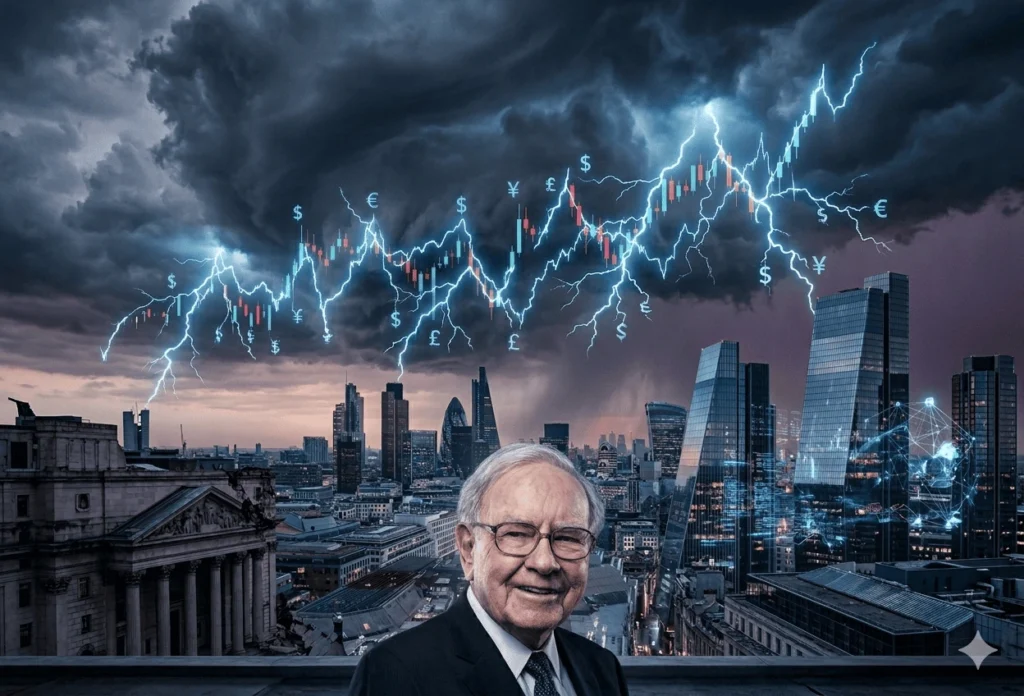

Stock Market Disconnect 2026, this document is provided strictly for educational and informational purposes and does not constitute professional financial, investment, legal, or tax advice. The information contained herein is synthesized from market data and historical analysis and should not be viewed as a recommendation to buy, sell, or hold any specific security or to adopt any particular investment strategy. Investing in the equity markets involves significant risk, including the total loss of principal. Past performance, particularly during idiosyncratic market regimes, is not a reliable indicator of future results. All investment decisions should be made in consultation with a qualified financial professional or licensed investment advisor. The author and publisher disclaim any liability for financial losses arising from the use of this content.
Stock Market Disconnect 2026
INTRODUCTION: THE GREAT MARKET DISCONNECT
In the discipline of macro-strategy, there is a fundamental axiom that serves as the North Star for all long-term capital allocation: Price determines the return. However, as we navigate the complex landscape of 2026, a profound and statistically rare disconnect has emerged between asset prices and the underlying economic reality. We are currently witnessing a market that appears to be signaling “all clear” while the structural pillars of global stability are under significant duress.
On one side of the ledger, we are confronted with escalating geopolitical friction in the Middle East, erratic trade policy shifts, and a looming threat to the world’s most critical energy infrastructure. On the other side, the S&P 500 remains buoyant, trading near historical highs at valuations that have, in every prior instance, preceded “lost decades” of flat or negative real returns. This gap—the “Great Disconnect”—suggests that the equity risk premium has been compressed to a level that leaves virtually no margin for error.
For the disciplined investor, this is not a signal for blind panic, but a call for rigorous fundamental selectivity. The market is currently priced for perfection in an environment defined by volatility. To succeed in the coming decade, investors must move beyond the “passive indexing” euphoria of the last ten years and embrace a strategy rooted in intrinsic value and secular mean reversion.
Stock Market Disconnect 2026
MACRO ANALYSIS: UNDERSTANDING THE HEADWINDS
To contextualize the current market environment, one must look past the daily price movements of the “Magnificent Seven” and analyze the structural headwinds that threaten to catalyze a significant multiple compression across the broader indices.
Geopolitical and Energy Risks: The Hormuz Factor
The geopolitical landscape in 2026 is defined by active military conflicts that directly threaten the global energy supply chain. The focal point of this risk is the Strait of Hormuz, a narrow waterway between Iran and Oman. This corridor is the single most critical choke point on the planet, with approximately 20% of the world’s daily oil flow passing through its waters.
The macro implications are severe: any credible threat to shipping in this region creates immediate upward pressure on crude oil prices. This is not merely a “commodity problem”; it is a “Fed problem.” Elevated energy costs manifest as “sticky” inflation (CPI and PPI), which effectively ties the hands of the Federal Reserve. If inflation remains structurally elevated due to supply-side shocks in the Middle East, the Fed loses the ability to cut interest rates—even if the domestic economy begins to show signs of recession. This “higher-for-longer” environment acts as a gravity well for equity valuations, particularly for high-duration growth stocks.
Trade Policy Volatility and the Cost of Uncertainty
We are operating in an era of unprecedented trade policy volatility. The constant cycle of tariff announcements, subsequent pauses, and aggressive renegotiations creates a climate of extreme uncertainty that is toxic to corporate Capital Expenditure (CapEx) cycles.
In professional finance, we understand that uncertainty is often more damaging than a known cost. When management teams cannot forecast their input costs or supply chain stability for the next four to eight quarters, they inevitably pull back on hiring, R&D, and expansion. While these contractions do not always manifest in the quarterly earnings of the current period, they erode the future earnings power that supports high P/E multiples.
The Valuation Crisis: A Historical Perspective
When we apply a historical lens to current market levels, the data is unmistakable. Two primary metrics indicate that the market has entered “extraordinary outlier” territory:
- The Shiller PE Ratio (CAPE): This metric smooths out short-term economic noise by comparing current prices to ten years of inflation-adjusted earnings. Historically, the mean Shiller PE is approximately 17. In 1929, prior to the Great Depression, the ratio hit 31. At the peak of the 1999 Dot-com bubble, it reached a record 44. Today, the market sits at a “smidge under 39.” This is the second-highest reading in nearly 150 years of market history—higher than the 1929 peak and higher than the late 1960s, a period so overvalued that Warren Buffett famously closed his investment fund, citing a lack of bargain opportunities.
- The Buffett Indicator: This ratio—Total Market Cap to US GDP—is often cited by Warren Buffett as the most reliable thermometer for valuation. In the 2000 bubble, the market reached approximately 45% to 47% overvalued. Today, the market is between 115% and 130% overvalued. We are currently witnessing a deviation from the historical mean that dwarfs the 1999-2000 era, suggesting that the broad index is pricing in growth that the underlying economy may be unable to provide.
Institutional Concentration: The Illusion of Diversification
The S&P 500 has evolved from a broad representative of the American economy into a concentrated tech proxy. The “Magnificent Seven” (Nvidia, Apple, Microsoft, Amazon, Alphabet, Meta, Tesla) now command a staggering 35% weight in the index. To put this in perspective, during the peak of the Dot-com bubble, the top seven companies held roughly half of that concentration. Passive investors who believe they are “diversified” are, in reality, making a highly leveraged bet on seven specific business models. If these seven names experience a secular downturn, the entire index will likely follow, regardless of the health of the other 493 companies.
Stock Market Disconnect 2026
SECTOR DEEP DIVE: THE MAGNIFICENT SEVEN AND AI EXUBERANCE
The dominance of these seven giants has been fueled by a potent cocktail of genuine operational excellence and “pure euphoria” surrounding Artificial Intelligence. While these are historically dominant businesses with incredible free cash flow, the market has priced them for a scenario of “perpetual perfection.”
Representative Market Leader Analysis: Nvidia (NVDA)
| Metric | Current Status / Value | Analyst Sentiment & Market Position |
| Market Position | Global hegemon in AI compute and GPU architecture. | Dominant. Nvidia remains the primary beneficiary of the AI infrastructure “arms race,” maintaining a near-monopoly on high-end data center GPUs. |
| Current Market Price | [Insert Current Market Price] | Aggressive. The price reflects an expectation of triple-digit growth continuing indefinitely, leaving the stock vulnerable to any “digestion period” in AI spending. |
| Analyst Target | [Insert Latest Target] | Polarized. While growth targets are high, strategists are increasingly concerned with “valuation gravity” and the sustainability of current margins. |
| Valuation Context | Historically Unusual | Extreme. Trading at multiples that are significant outliers compared to 10-year historical averages, suggesting “priced for perfection” status. |
Analytical Commentary (The Verdict): History is littered with “amazing businesses” that became “terrible stocks” because of the price paid at entry. The Magnificent Seven are facing a difficult hurdle: justifying 2026 valuations over a long-term horizon. If AI adoption rates slow or if the “return on AI investment” for their customers is delayed, the repricing risk (multiple compression) for these giants is substantial. Asymmetric downside risk is currently higher than the potential for continued exponential upside.
Stock Market Disconnect 2026
CORE INVESTMENT STRATEGY: PRINCIPLE-DRIVEN INVESTING
In an environment where “something isn’t right” at the index level, the path forward is a transition from passive participation to Principal-Driven Investing. This philosophy rejects the “buy the dip” mentality in favor of “buy the value.”
The Five Tenets of Principal-Driven Investing
To navigate a decade that may yield flat returns for the S&P 500, investors should adhere to these five pillars:
- Fundamental Analysis: Moving beyond ticker symbols to understand how a business actually generates revenue.
- Valuation Discipline: Utilizing DCF (Discounted Cash Flow) models to ensure the price paid provides a margin of safety.
- Competitive Advantage (The Moat): Identifying businesses with high barriers to entry that can maintain pricing power during inflationary cycles.
- Balance Sheet Strength: Prioritizing companies with low debt and high interest-coverage ratios, especially in a “higher-for-longer” interest rate environment.
- Management Quality: Investing in leadership teams that prioritize capital allocation and shareholder returns over growth-at-any-cost.
Strategic Investment Vehicles for 2026
- Equal Weighted S&P 500 (e.g., RSP)
- Tracking Objective: Assigns a 0.2% weight to every company in the S&P 500.
- Strategic Advantage: Systematically eliminates the concentration risk of the Magnificent Seven. It provides exposure to the “other 493” companies that may be more reasonably priced.
- Analyst Pro Tip: Use RSP to capture the “mean reversion” of mid-cap and value stocks when the mega-cap tech trade eventually cools.
- Dividend Growth/Value ETFs (e.g., SCHD)
- Tracking Objective: Focuses on high-quality firms with consistent dividend growth and sustainable payout ratios.
- Strategic Advantage: In a “flat decade,” dividends represent a significant portion of total return. SCHD acts as a psychological and financial anchor during periods of market stagnation.
- Analyst Pro Tip: Focus on “Qualified Dividends” and low turnover to minimize tax leakage, which is vital when capital gains are scarce.
- Broad Market Exposure (e.g., VTI)
- Tracking Objective: Total US Stock Market coverage.
- Strategic Advantage: Best utilized for long-term Dollar-Cost Averaging (DCA).
- Analyst Pro Tip: Maintain DCA during “red days.” Mathematically, you are lowering your cost basis, which is the only way to turn a stagnant market into a profitable one over a 20-year horizon.
- Individual Business Selection
- Tracking Objective: Identifying idiosyncratic mispricings.
- Strategic Advantage: Allows the investor to find “the baby thrown out with the bathwater”—high-quality companies punished by general macro fear.
- Analyst Pro Tip: Deploy capital based on intrinsic value calculations rather than technical support levels during periods of macro-driven volatility.
- Cash Reserves/Short-Term Treasuries
- Tracking Objective: Liquidity and capital preservation.
- Strategic Advantage: Cash is not a “drag” on the portfolio; it is “optionality.”
- Analyst Pro Tip: High-yield cash reserves allow you to “sleep better at night” and act aggressively when the market finally offers deep discounts.
- AI Infrastructure Focus
- Tracking Objective: Identifying the “shovels” of the AI era (utilities, cooling systems, specialized semiconductors).
- Strategic Advantage: Captures the secular AI trend without the “software-as-a-service” (SaaS) hype.
- Analyst Pro Tip: Look for companies with real, tangible earnings today, not “potential” earnings in 2030.
10 MARKET GIANTS DRIVING THE INDEX
The following ten heavyweights dictate the direction of the market. Their valuations represent the “ceiling” and “floor” of current investor sentiment.
- Nvidia (NVDA): The AI compute engine. Verdict: A generational business, but the current multiple leaves zero room for even a minor earnings miss.
- Apple (AAPL): The services and hardware fortress. Verdict: Trading at a historically high P/E relative to its current low-single-digit growth rate. Vulnerable to multiple compression.
- Microsoft (MSFT): The cloud and enterprise AI leader. Verdict: High-quality “staple,” but investors are paying a significant premium for its Co-Pilot integration.
- Amazon (AMZN): E-commerce and AWS powerhouse. Verdict: Strong free cash flow, though susceptible to consumer discretionary pullbacks if the Strait of Hormuz impacts gas prices.
- Alphabet (GOOGL): The data and search king. Verdict: Perhaps the most “reasonably” valued of the Mag 7, though regulatory risks remain a significant overhang.
- Meta (META): The ad-revenue and Metaverse disruptor. Verdict: Efficiency and AI implementation have driven prices up; now requires flawless execution to maintain levels.
- Tesla (TSLA): EV and robotics pioneer. Verdict: High volatility; current valuation depends on “Full Self-Driving” (FSD) and robotics, not just car sales.
- Berkshire Hathaway (BRK.B): The ultimate defensive anchor. Verdict: Boasts a massive cash pile. This is the “sleep well at night” stock for a high-valuation market.
- Eli Lilly (LLY): Healthcare giant leading the GLP-1 (weight loss) revolution. Verdict: Strong growth profile, but the “weight loss hype” has pushed the forward P/E into tech territory.
- Broadcom (AVGO): Critical AI and networking infrastructure. Verdict: A “hidden” giant in the semiconductor space; essential for AI data centers, yet often overlooked by retail.
FAQ: INVESTOR STRATEGY & MARKET OUTLOOK
Why is the current S&P 500 concentration risk considered a historic outlier?
Stock Market Disconnect 2026
Historically, the S&P 500 was balanced across industrials, energy, and financials. Today, 35% of the index is concentrated in just seven technology-driven names. During the 1999 Dot-com bubble, the concentration of the top seven was nearly half of what it is today. This means that a passive investor is no longer diversified; they are making a concentrated sector bet. If these specific companies stumble, the “diversified” index will suffer a disproportionate drawdown.
How does the “Buffett Indicator” compare today to the Dot-com bubble?
In the year 2000, the Buffett Indicator (Total Market Cap to GDP) suggested the market was roughly 45% to 47% overvalued. As of 2026, we are seeing readings of 115% to 130% overvalued. This is a staggering deviation from the historical norm. While the economy has grown, the stock market has grown at a rate that is fundamentally unsustainable relative to the GDP it relies upon, suggesting we are in a period of “extraordinary outlier” valuations.
Does a Shiller PE of 39 guarantee a market crash next week?
No. Valuation metrics like the Shiller PE (CAPE) are notoriously poor timing tools. The market can remain irrational and expensive for years. However, a Shiller PE of 39 is a highly accurate predictor of ten-year returns. History shows that whenever the ratio enters this territory (as it did in 1929 and 1999), the following decade yields disappointing, often negative, real returns for passive investors.
What are the specific advantages of Tax-Efficient ETFs in a flat market?
In a “lost decade” where capital appreciation may be minimal, “leakage” through taxes and fees becomes your greatest enemy. By utilizing low-turnover ETFs and those that focus on Qualified Dividends (taxed at a lower rate), you preserve more of your total return. This focus on “keeping what you earn” is often the difference between a portfolio that grows and one that stagnates during a sideways market regime.
Why is the Strait of Hormuz a primary concern for equity investors?
If the Strait of Hormuz is disrupted, global oil prices spike. Because energy is an input for almost everything, this leads to “sticky” inflation. This forces the Federal Reserve to maintain high interest rates to cool the economy. Higher rates make bonds more attractive relative to stocks and increase the “discount rate” used to value future earnings, which almost always results in lower stock prices.
How should I view “Dollar-Cost Averaging” (DCA) right now?
DCA is actually most effective in a volatile or flat market. By investing a set amount every month, you naturally buy more shares when the market is “on sale” (red days) and fewer when it is overvalued (green days). Over a 20-year period, this mathematically lowers your average cost per share, allowing you to profit even if the market spends several years “going nowhere.”
What is the difference between “Excitement” and “Euphoria” in this market?
Euphoria is the blind belief that prices will go up forever regardless of the price paid. Excitement, for the disciplined investor, is seeing a “red day” as an opportunity to buy a great business at a discount. The goal of Principal-Driven Investing is to use knowledge of fundamentals to turn the fear of a bear market into the excitement of a buying opportunity.
Is it wise to sell everything and move to cash?
Absolutely not. Market timing is a loser’s game. Even in the late 1960s or 1999, there were individual companies that outperformed. The correct move is to adjust your approach—holding a bit more cash as “dry powder,” focusing on equal-weighted indices to reduce concentration risk, and being extremely selective about the individual businesses you own.
How do I identify a “mispriced” company in an expensive market?
This is the “detective work” of investing. Look for companies whose stock prices have fallen due to “macro contagion”—meaning they were sold off because investors are afraid of the general economy, even though the specific company’s earnings, balance sheet, and competitive moat remain perfectly intact. These are cases where the “baby was thrown out with the bathwater.”
Can AI eventually justify these valuations?
AI is a genuine secular shift, similar to the internet in the 1990s. However, history shows that the first wave of winners often over-expands. In 1999, the internet was “real,” but many of the stocks were bubbles that took 15 years to recover. The technology can be transformative while the current stock price remains fundamentally “wrong.”
Stock Market Disconnect 2026
CONCLUSION: THE LONG-TERM THESIS
The year 2026 represents a crossroads for the modern investor. While the headlines may celebrate new highs, the underlying data—from the Strait of Hormuz to the Shiller PE—suggests that “something isn’t right.” We are in a market regime defined by asymmetric downside risk, where the cost of being “wrong” is significantly higher than the reward for being “right” in the short term.
However, for the disciplined strategist, this environment creates a unique opportunity. By moving away from the “Magnificent Seven” concentration and toward the Five Tenets of Principal-Driven Investing, you can navigate this disconnect. Success in the next decade will not come from blindly following the index, but from:
- Selective Discipline: Buying only what is truly mispriced.
- Patience: Utilizing cash reserves as a strategic asset.
- Compounding: Using Dollar-Cost Averaging to turn market volatility into a long-term advantage.
Remember: the more you pay for a stream of income, the lower your return will be. By focusing on what a business is actually worth—rather than what the daily ticker says—you can turn a “lost decade” into a period of significant wealth accumulation. Stay grounded, avoid the euphoria, and treat every red day as a step toward your long-term goals.
Stock Market Disconnect 2026
FINAL DISCLAIMER
Investing in securities involves a high degree of risk and the potential for total loss of capital. This report is for educational purposes only and is not a recommendation to trade. Historical data points, such as the Buffett Indicator or Shiller PE, are analytical tools and not guarantees of future market movement. Always conduct your own due diligence and consult with a licensed financial advisor before making any investment.















![Truths About Neptune Insurance That Nobody Tells You [2026]](https://brayzor.com/wp-content/uploads/2026/03/Truths-About-Neptune-Insurance-That-Nobody-Tells-You-2026-1-300x204.webp)













































![Truths About Neptune Insurance That Nobody Tells You [2026]](https://brayzor.com/wp-content/uploads/2026/03/Truths-About-Neptune-Insurance-That-Nobody-Tells-You-2026-1-1024x696.webp)