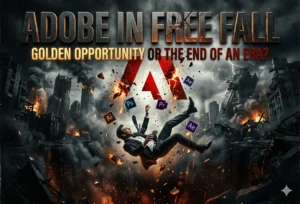
Adobe in Free Fall, the fundamental-valuation disconnect in the software sector has reached a breaking point, and Adobe is ground zero. The company recently reported a decisive double-beat on both revenue and earnings, yet the stock plummeted toward a new 52-week low. Despite delivering 12% revenue growth ($6.4 billion) and a 19% surge in EPS, Adobe is down approximately 23% year-to-date and nearly 50% from its all-time high.
The market is currently pricing in a “Doomsday” scenario that isn’t supported by the fundamentals. While Wall Street reacts to a narrative of imminent AI obsolescence, the actual data reveals a business that is not just surviving, but thriving in a period of intense market rotation.
Under the Hood: The Financial Fortress
Adobe is not a struggling legacy business; it is a high-margin cash-flow machine. The company’s “A+” profitability metrics distinguish it from every other peer in the SaaS universe.
- Recurring Revenue Powerhouse: Adobe commands between $24 billion and $26 billion in annual recurring revenue, providing a bulletproof foundation for long-term forecasting.
- Elite Efficiency: The company maintains a 90% gross margin and an operating margin of 38%. Even more critical for institutional analysts is the 38% Return on Invested Capital (ROIC), a phenomenal figure that proves management’s ability to effectively allocate capital in the AI era.
- Aggressive Shareholder Yield: Management is exploiting the valuation gap by cannibalizing its own shares. The share count has dropped from 493 million to less than 420 million—a 15% reduction that significantly amplifies EPS for remaining holders.
- Cash Flow Dominance: Adobe generates over $10 billion in annual free cash flow, with margins that are not only above the sector average but are actually improving relative to the company’s own historical benchmarks.
BALANCE SHEET STRENGTH: NET DEBT TO EBITDA Adobe’s financial position is effectively bulletproof. With $6.6 billion in cash on hand and equivalent debt levels, its net debt is effectively zero. In a liquidation scenario, Adobe could extinguish its entire debt load in just a few days of operations.
Adobe in Free Fall
The Bear Narrative: Why Wall Street is Panicking
The current collapse is driven by a narrative of “Forward-Looking Fear.” Three specific catalysts have created a vacuum of confidence:
- Generational AI Disruption: The rise of Midjourney, Runway, Stable Diffusion, and OpenAI’s image tools has triggered a panic. Analysts fear that if AI can generate professional-grade content instantly, the need for high-priced design suites like Photoshop and Illustrator will evaporate.
- The Barclays Downgrade: Barclays recently slashed its price target to $275, explicitly warning that generative AI could cannibalize the demand for traditional stock images and professional workflows.
- The Leadership Vacuum: After an 18-year tenure, Adobe’s CEO is stepping down. The announcement came “out of the blue” with no successor identified. This has left institutional investors in a “position of discomfort” and “limbo,” forced to navigate the most pivotal technological shift in 30 years without a designated captain.
The Creative Sector Power Players: Status Report
Adobe no longer owns the field. To value the stock, you must understand the ecosystem:
- Adobe: The incumbent powerhouse attempting to weaponize AI integration to defend its user base.
- OpenAI: The primary disruptor challenging Adobe’s core creative value proposition with text-to-image and video.
- Midjourney: The leader in high-fidelity generative imagery, siphoning off individual creators.
- Runway: The pioneer in AI video generation, targeting the Premiere Pro and After Effects moats.
- Stable Diffusion: The open-source threat that democratizes creative AI outside of proprietary ecosystems.
- Microsoft: The benchmark for enterprise AI integration; a key indicator of how AI spend is being prioritized.
- Salesforce: A SaaS peer facing a similar market rotation and multiple compression.
- Intuit: The Ad-Spend Benchmark. Intuit spends $1.4B+ on advertising to protect its market; Adobe is now matching this offensive.
- Meta: A major competitor for the infrastructure and digital attention required to power AI creative tools.
Growth Potential & Strategic Pivots
Adobe is executing a high-stakes defensive and offensive strategy to maintain its “platform of choice” status:
- The $1.4 Billion Ad Offensive: Adobe has boosted its advertising budget to match the scale of leaders like Intuit. This 5% of revenue spend is a direct effort to combat the disruption narrative.
- Embedded AI Workflows: By embedding generative AI directly into Photoshop and Illustrator, Adobe aims to make AI a feature of their ecosystem rather than a replacement for it.
- Institutional “Smart Money” Support: Retail investors are panicking, but the “Smart Money” is buying. Institutions hold 80% of shares. Throughout 2025, institutional buying (26 billion) has consistently outpaced selling (19 billion).
Macro Analysis: The -6% Growth Paradox
The market is currently pricing Adobe like a “melting ice cube.” In a period where the S&P 500 is flush with green, Adobe is being valued based on a -6% long-term growth rate.
This is an absurdity when compared to the reality on the ledger. Adobe has grown its free cash flow by 9% annually over the last five years and 25% in the most recent year. The divergence between a -6% priced-in growth rate and a 25% actual growth rate is where the generational opportunity—or the trap—lies.
Adobe in Free Fall
Valuation Breakdown: The Margin of Safety
Using a Discounted Cash Flow (DCF) model with conservative inputs, the mispricing becomes undeniable.
| Metric | Value / Estimate |
| Current Forward P/E | 11x – 12x |
| Historical 5-Year Average P/E | 29x |
| Intrinsic Value Estimate (DCF) | $378 – $505 |
| Implied Upside | 34% to 77% |
| Margin of Safety (MOS) | 44% (at 2% growth) |
| Priced-in Growth Rate | -6% (Market Expectations) |
Even with zero growth, the upside is 53%. At a conservative 2% growth rate, the intrinsic value hits $505, offering a massive 44% Margin of Safety.
Adobe in Free Fall
Investor FAQ
1. Why is Adobe stock dropping despite beating earnings? Fear regarding AI disruption and a sudden leadership transition is outweighing current financial performance.
2. Is AI a threat to Adobe Photoshop? It is a threat to the workflow, but Adobe is betting that by integrating AI into its existing tools, it will remain the industry standard.
3. What is Adobe’s current intrinsic value? Conservative DCF models suggest an intrinsic value between $378 and $505 per share.
4. Is Adobe stock a “value trap” in 2025? A value trap requires deteriorating business fundamentals. With 12% revenue growth and 25% FCF growth, the business remains robust.
5. How much recurring revenue does Adobe have? Adobe commands between $24 billion and $26 billion in annual recurring revenue.
6. Who are Adobe’s main AI competitors? The primary disruptors are OpenAI, Midjourney, Runway, and Stable Diffusion.
7. What happened to Adobe’s CEO? After 18 years, the CEO announced a sudden exit without a named successor, creating a “limbo” period for investors.
8. How does Adobe’s margin compare to other tech companies? Adobe’s 90% gross margins and 38% operating margins are elite, far exceeding the software sector average.
9. Are institutional investors selling Adobe? No. Institutional buying (26B) significantly outpaced selling (19B) all throughout 2025.
10. Is Adobe’s balance sheet healthy? Yes. With effectively zero net debt and $6.6 billion in cash, it is one of the strongest balance sheets in tech.
The Final Verdict
The question for investors isn’t whether AI is a threat—it’s whether a fortress-balance sheet company with 90% margins and a 38% ROIC deserves to be priced for terminal decline. The market is pricing in a 6% annual contraction for a company that just grew its cash flow by 25%.
The numbers say no; the narrative says yes. The gap between those two positions is where the opportunity lies. Adobe is trading at its cheapest valuation in history, offering a 44% Margin of Safety for those who believe its ecosystem is more durable than the headlines suggest. In the era of AI, the only certainty is change, but the price of entry has rarely been this attractive.
Disclaimer: All investing carries risk. This report is for informational and educational purposes only and does not constitute financial advice. Past performance is not indicative of future results. Always perform individual research or consult with a qualified financial advisor before making investment decisions.