Introduction: The 2026 Strategic Pivot
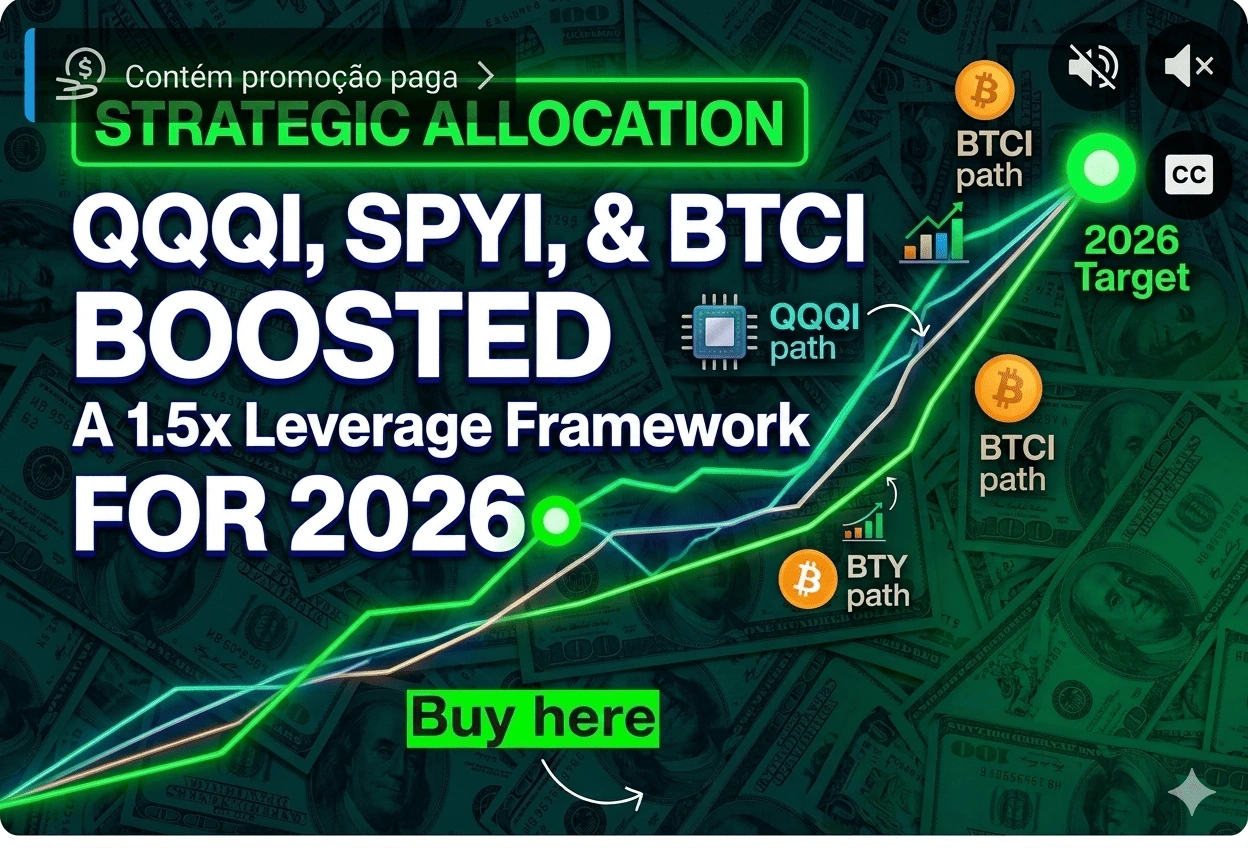
Strategic Allocation into QQQI, SPYI, and BTCI in the current climate of heightened geopolitical tension and macro-economic uncertainty, the prevailing retail sentiment is a retreat toward “defensive” or “risk-off” assets. However, from a systematic investment perspective, this volatility offers a unique window for capital efficiency. My strategic pivot for 2026 involves a disciplined move toward “boosted” total return instruments, specifically targeting 1.5x leveraged ETFs to enhance long-term compounding.
The core thesis of this strategy is the utilization of NEOS “Boosted” ETFs within a Roth IRA to maximize total returns while bypassing the tax drag associated with high-yield instruments. I have initiated $500 starter positions in three core vehicles—XQQI, XSPI, and XBCI—demonstrating a commitment to aggressive growth and enhanced distribution profiles over traditional downside protection.
Strategic Allocation into QQQI, SPYI, and BTCI
The New Era of Yield: Key Investment Vehicles and Issuers
The income-focused leverage sector is evolving rapidly, with a few key entities and benchmarks defining the landscape. Understanding the relationship between underlying benchmarks and their leveraged counterparts is essential for proper portfolio construction.
- NEOS (Issuer): An innovative fund manager that has pioneered a spectrum of ETFs ranging from hedged equity (risk-off) to high-equity income and now “boosted” (aggressive) categories.
- QQQI (Nasdaq-100 High Income ETF) & XQQI (1.5x Strategy): QQQI serves as the technology-heavy benchmark; XQQI applies a 1.5x overlay to amplify both the capital appreciation and the distribution yield of the Nasdaq-100.
- SPYI (S&P 500 High Income ETF) & XSPI (1.5x Strategy): While SPYI provides a baseline 10–12% yield on the S&P 500, XSPI scales this exposure to capture greater upside and a higher distribution target.
- BTCI (Bitcoin High Income ETF) & XBCI (1.5x Strategy): BTCI provides exposure to Bitcoin with a distribution component; XBCI is the aggressive 1.5x counterpart designed for high-conviction positioning during crypto-asset pullbacks.
- Tap Alpha (Issuer): A secondary issuer mentioned in the strategic landscape that utilizes similar leverage mechanics to enhance portfolio yield.
- J.P. Morgan (Competitor – JPI/JPQ): Institutional benchmarks in the active income space. While they offer significant liquidity, they often lack the 1.5x “boosted” structure and the specific tax advantages found in the NEOS ecosystem.
Deep Dive: The “Boosted” Triumvirate
It is critical to note that because these funds are recently launched, the following performance data represents synthetic projections based on 12-month back-testing of the underlying strategies, rather than realized fund history.
XQQI (1.5x QQQI)
XQQI targets the Nasdaq-100 with a 1.5x leverage overlay, specifically engineered for investors who prioritize total return maximization over volatility mitigation.
- Growth & Income Potential (Synthetic Projections):
- Targeted distribution rates significantly higher than the standard QQQI yield.
- 12-month back-test indicates a synthetic total return of 30.3%.
- Utilization of Section 1256 contracts to optimize tax efficiency for non-qualified accounts.
XSPI (1.5x SPYI)
Positioned as a core aggressive holding, XSPI applies a 1.5x multiplier to the S&P 500 high-income strategy. The fund has already attracted $20 million in Assets Under Management (AUM), signaling strong early institutional and retail interest.
- Growth & Income Potential (Synthetic Projections):
- Targeted annualized distribution rate of 15–18% after fees and expenses.
- Synthetic 12-month trailing total return projected at 23.3%.
- Captures 1.5x the performance of the standard SPYI (which yields roughly 10–12%).
XBCI (1.5x BTCI)
XBCI provides leveraged exposure to the Bitcoin ecosystem. Despite the underlying asset entering a “deep red” phase recently, the fund’s structure allows for disciplined “averaging down” to secure a lower cost basis ahead of the 2026 cycle.
- Growth & Income Potential (Synthetic Projections):
- Enhanced distribution profile; the underlying BTCI has historically reached distribution levels near 44%.
- While the 12-month synthetic return was -17.1%, the total return significantly outperformed the raw price movement of the underlying asset.
- Strategically positioned to compound rapidly during periods of Bitcoin price appreciation.
Macro Analysis: The Evolution of the Income ETF Industry
The recent influx of leveraged income ETFs followed a period of regulatory stagnation caused by government-related delays. Once cleared, issuers like NEOS and Tap Alpha released a suite of products that allow investors to build a “risk-spectrum” portfolio.
The industry has moved toward a “middle ground” of 1.2x to 1.5x leverage. As a systematic strategist, I favor the 1.5x multiplier because it optimizes the balance between capital efficiency and volatility decay. Unlike 2x or 3x daily-reset funds—which suffer from severe “path dependency” and the mathematical reality that a 10% drop followed by a 10% gain results in a net loss—1.5x leverage provides a “sweet spot.” It captures outsized upside while minimizing the compounding errors common in highly leveraged instruments.
Strategic Allocation into QQQI, SPYI, and BTCI
Comparative Data: Standard vs. Boosted Performance
The following table illustrates the performance of the underlying benchmarks against the projected performance of their 1.5x synthetic counterparts over a 12-month trailing period.
12-Month Performance Comparison (Underlying vs. 1.5x Synthetic Projections)
| ETF Ticker (Underlying / Boosted) | 1-Year Total Return (Standard) | 1-Year Total Return (1.5x Synthetic) |
| QQQI / XQQI | 20.2% | 30.3% |
| SPYI / XSPI | 15.5% | 23.3% |
| BTCI / XBCI | -11.4% | -17.1% |
The Tax and Fee Reality Check
The outsized returns provided by boosted funds are accompanied by a specific “cost of carry” and “tax drag” that must be accounted for in any systematic model.
- Expense Ratios: These funds are not low-cost index trackers. Management fees are approximately 1% due to the inherent costs of maintaining the leverage component and the synthetic overlay.
- Section 1256 Advantages: Unlike J.P. Morgan’s JPI or JPQ, which are often taxed at 100% short-term capital gains rates, these NEOS funds utilize Section 1256 contracts. This allows for a 60/40 tax split (60% long-term / 40% short-term), providing a significant advantage in taxable accounts.
- The Roth IRA Strategy: My personal preference is to hold these assets in a Roth IRA. This allows the strategy to bypass the complexities of Section 1256 entirely, enabling the enhanced distributions to compound without any tax erosion.
FAQ: Navigating Leveraged Income ETFs
What are NEOS Boosted ETFs?
They are exchange-traded funds that apply a 1.5x leverage overlay to high-income equity and digital asset strategies, targeting enhanced total returns and higher monthly distributions.
How does 1.5x leverage differ from 2x or 3x funds?
1.5x leverage is a moderate alternative designed to mitigate the volatility decay and path-dependency risks associated with more aggressive 2x or 3x daily-reset instruments.
What is the target yield for XSPI?
XSPI aims for an annualized distribution rate of approximately 15% to 18% after accounting for management fees and leverage costs.
What are Section 1256 contracts?
These are specialized financial contracts that receive a favorable tax treatment of 60% long-term and 40% short-term capital gains, regardless of the investor’s holding period.
Why invest in XBCI when Bitcoin is down?
Systematic investing requires “averaging down” during periods of deep price contraction. This secures a lower cost basis and maximizes the compounding effect of distributions when the asset class recovers.
What are the risks of using leverage in a volatile market?
Leverage amplifies both gains and losses. In a declining market, a 1.5x fund will experience a faster drawdown than its non-leveraged counterpart, as evidenced by XBCI’s -17.1% synthetic return.
How did QQQI perform on a total return basis last year?
In the trailing 12-month period, QQQI achieved a total return of 20.2%, driven by strong Nasdaq performance and reinvested distributions.
Are these funds suitable for investors living off dividends?
These funds are best suited for investors in the growth or “accumulation” phase. The price volatility associated with 1.5x leverage can be challenging for those requiring a stable principal for immediate withdrawal.
Why are the expense ratios for Boosted ETFs higher?
The ~1% expense ratio reflects the operational cost of borrowing, managing the synthetic options overlay, and maintaining the 1.5x exposure.
What is the difference between Price Return and Total Return for these funds?
Price return only accounts for the change in share price, whereas Total Return includes the reinvestment of distributions. For example, BTCI’s price dropped -37.5% over a 12-month period, but its Total Return was mitigated to a -11.4% loss thanks to its 44% yield.
Strategic Allocation into QQQI, SPYI, and BTCI
Conclusion: The Long-Term Compounding Plan
The strategy for 2026 is defined by conviction and capital efficiency. By reallocating into “Boosted” vehicles like XQQI, XSPI, and XBCI, investors can capture amplified market gains while generating high-velocity income.
While market corrections are inevitable, I view them as opportunities to increase position sizes at lower entry points. For investors with a long-term horizon and the ability to withstand short-term volatility, doubling down on these 1.5x “boosted” assets offers a potent path toward portfolio outperformance and aggressive wealth accumulation by 2026.