
1. The “Bottleneck Thesis” Introduction
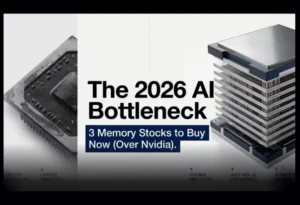
Top 3 Infrastructure Stocks, in the investment cycle of 2023–2024, the “Compute Era” dominated the narrative, fueled by an insatiable demand for Nvidia’s GPUs. However, as we enter 2026, the primary constraint of the AI value chain has undergone a fundamental shift. While processing power has scaled exponentially, the industry has hit a physical wall: the inability to feed data to these processors fast enough to prevent performance stalls.
Compute is no longer the scarce resource; data movement is. To solve this, the sector has transitioned into the “Memory Era,” centered on High Bandwidth Memory (HBM). Rather than traditional flat architectures, HBM involves the sophisticated physical stacking of memory chips directly atop one another, placed in extreme proximity to the GPU. For investors, HBM represents a formidable economic moat; the extreme manufacturing complexity and yield-sensitivity of stacking these chips create a high barrier to entry that preserves a lucrative oligopoly. In 2026, HBM is the essential hardware layer that prevents the world’s most expensive data centers from idling.
Top 3 Infrastructure Stocks
2. Macro Analysis: The $500 Billion AI Infrastructure Wave
The transition to a memory-centric thesis is underpinned by unprecedented “Capex intensity.” The world’s largest technology “hyperscalers” are no longer just participating in an AI race; they are fortifying city-sized infrastructure hubs with committed budgets that exceed the GDP of mid-sized nations.
Total annual spending among the top four players is projected to surpass $500 billion in 2026. This environment favors an oligopoly structure, where only three primary manufacturers possess the technical capability to produce high-end HBM. This concentration of supply grants these players immense pricing power as hyperscalers compete for limited capacity.
Projected 2026 AI Infrastructure Spend by Hyperscaler
| Company | Projected 2026 Infrastructure Capex |
| Amazon | $200 Billion |
| Alphabet | $185 Billion |
| Meta | $125 Billion |
| Microsoft | ~$100 Billion |
3. The 10 Titans Dominating the AI Infrastructure Sector
The following entities represent the critical nodes in the 2026 AI memory and infrastructure ecosystem:
- Micron: The direct bottleneck supplier producing the HBM essential for high-performance AI silicon.
- Samsung: The industry’s manufacturing muscle, leveraging massive scale to dominate the high-margin HBM4 market.
- Rambus: An IP-centric powerhouse managing the complexity of signal integrity as data speeds accelerate.
- Amkor Technology: A critical provider of the advanced packaging required to assemble complex stacked-chip architectures.
- Nvidia: The primary system architect whose “Vera Rubin” platform is physically dependent on next-gen memory.
- SK Hynix: A pioneer in the HBM oligopoly and a leading supplier for premium AI data center platforms.
- Meta: A massive infrastructure spender with a $125 billion commitment to sovereign AI and social modeling.
- Microsoft: A cornerstone of the cloud AI wave, directing nearly $100 billion toward infrastructure expansion.
- Alphabet: A primary driver of memory demand as it integrates AI across the most utilized software stack on earth.
- Amazon: The leading global spender, committing $200 billion to maintain its dominance in cloud infrastructure.
4. Deep Dive: Micron (The Direct Bottleneck Play)
Micron represents the most direct play on the AI memory bottleneck. In 2026, we are witnessing a significant margin inflection as the company shifts its product mix from commodity DRAM to high-margin HBM. A sophisticated analyst will note a “masked growth” effect currently at play: while Micron’s traditional consumer memory segments are navigating a cyclical downturn, its AI-driven cloud memory is seeing vertical expansion, de-risking the overall earnings profile.
With its newest iteration, HBM3e, already a staple in high-end systems, the focus has shifted to HBM4. As of early 2026, Micron’s HBM4 production capacity is entirely sold out, providing incredible revenue visibility into 2027.
Growth Potential: Micron’s Path to 2027
- Sold-Out Visibility: Full capacity commitment for HBM4 ensures a protected revenue stream regardless of near-term market volatility.
- Asymmetric Risk-Reward: The “masked growth” from HBM allows for significant upside as the cyclical traditional DRAM segment eventually recovers.
- Architectural Lock-in: Deep integration into Nvidia’s latest hardware designs makes Micron a non-discretionary partner in the AI stack.
5. Deep Dive: Samsung (The Scale and Value Play)
Samsung serves as the manufacturing powerhouse of the semiconductor sector. Currently, the stock represents a significant valuation disconnect; while peers have seen aggressive price appreciation, Samsung trades at a discount despite its “manufacturing flex”—the ability to pivot massive production capacity from low-margin DRAM to high-margin HBM almost instantly.
The primary catalyst for Samsung’s projected 42% upside is its design win for Nvidia’s ultra-high-performance “Vera Rubin” model. By securing a deal to supply HBM4 for this flagship platform, Samsung has validated its technical parity with SK Hynix (which carries a much more modest 15% upside projection). Having tripled its profit in the most recent quarter by focusing on these high-margin segments, Samsung is the premier play for investors seeking scale and value.
Top 3 Infrastructure Stocks
6. Deep Dive: Rambus (The Complexity/IP Play)
As AI servers grow denser, the challenge shifts from storage to signal integrity. Rambus operates at this “interface” layer, selling the intellectual property (IP) and specialized chips that allow data to move between memory and the processor without losing speed or clarity.
Rambus enjoys an enviable business model with 80% gross margins, a byproduct of its IP-centric approach. With a 40% market share in the DDR5 memory interface chip market, it is the ultimate “Picks and Shovels” play for the memory sector itself.
Risk Alert: Rambus (Volatility & Governance) Despite its high margins, Rambus’s $10 billion market cap makes it highly sensitive to AI spending shocks. Investors must monitor recent leadership changes, specifically the departure of the CFO without an immediate successor, which introduces an element of governance risk.
Top 3 Infrastructure Stocks
7. The Bonus Play: Amkor Technology
As the industry moves toward HBM4, the “Advanced Packaging and Testing” phase becomes a critical bottleneck. You cannot simply stack chips; you must assemble them with microscopic precision to ensure thermal and electrical efficiency. Amkor is the essential provider of this sophisticated assembly. While Amkor is vital to the 2026 landscape, its current valuation is at a premium, suggesting investors should wait for a more attractive entry point while acknowledging its indispensable role in the stacked-memory ecosystem.
Top 3 Infrastructure Stocks
8. Comparative Analysis: Growth Potential vs. Risk Factors
| Company | Primary Strength | Key Risk | Market Role |
| Micron | Direct Bottleneck / Sold-out Capacity | High sensitivity to Capex shifts | Essential HBM Supplier |
| Samsung | Balance Sheet / Manufacturing Flex | Global tariffs / Geopolitical friction | Value & Scale Giant |
| Rambus | 80% Gross Margins (IP-led) | High P/E / Management turnover | Complexity Manager |
Investor Exit Signals:
- Capex Stalls: Any plateau or reduction in the $500B+ annual hyperscaler infrastructure budgets.
- Pricing Power Erosion: An unexpected increase in supply or a breakdown of the current oligopoly pricing structure.
- Macro Instability: Geopolitical tensions or new tariffs affecting the South Korean supply chain (Samsung/SK Hynix).
Investor-focused FAQ
- Why is memory the new bottleneck for AI in 2026? Compute power has outpaced data retrieval speeds. AI models now stall because they cannot access data fast enough, making High Bandwidth Memory the primary constraint on system performance.
- What is High Bandwidth Memory (HBM)? HBM is a premium memory architecture that vertically stacks DRAM chips and places them directly on the GPU package. This reduces data travel distance, drastically increasing speed and lowering power consumption.
- Is Micron a better buy than Nvidia for AI growth? In 2026, Micron offers the “bottleneck” advantage that Nvidia held in 2023. With HBM4 capacity sold out, Micron provides high revenue visibility and margin expansion potential that may exceed a maturing Nvidia.
- Why is Samsung’s stock considered “cheap” compared to peers? Samsung trades at a significant valuation disconnect compared to SK Hynix. Analysts project a 42% upside as Samsung pivots its massive manufacturing capacity to high-margin HBM4 for Nvidia’s Vera Rubin platform.
- What does Rambus do in the AI sector? Rambus provides the IP and chips that manage the “interface” between memory and processors. They ensure data moves cleanly without signal loss as AI systems reach extreme speeds.
- How much are Big Tech companies spending on AI infrastructure? The four primary hyperscalers—Amazon, Alphabet, Meta, and Microsoft—are on track to spend over $500 billion combined on AI infrastructure in 2026 alone.
- What are the risks of investing in the cyclical memory market? The memory market is historically “boom and bust.” If AI spending slows, the current high margins will contract rapidly as the market reverts to commodity pricing.
- What is the growth rate of the HBM market? The HBM market is currently projected to grow at a Compound Annual Growth Rate (CAGR) of 27% through the next five years, driven by the shift toward HBM4.
- How does HBM4 differ from previous memory generations? HBM4 offers the increased density and speed required for next-generation systems like Nvidia’s “Vera Rubin.” It involves more complex stacking, further increasing the barrier to entry for competitors.
- What are the top 3 AI memory stocks to watch now? The top three plays are Micron (direct bottleneck), Samsung (value/scale with Vera Rubin catalyst), and Rambus (high-margin IP specialist).
10. Conclusion: The Next Trillion-Dollar Opportunity
The history of technology investing proves that the most significant returns accrue to those who identify the company that removes the current system constraint. In 2026, that constraint is the memory bottleneck. While the semiconductor industry remains inherently cyclical, the sheer scale of the current $500 billion annual infrastructure wave creates a fundamentally different environment than previous cycles.
Sophisticated investors must look beyond the “Compute Era” to the foundational layers of the stack. By positioning in bottleneck suppliers like Micron, manufacturing titans like Samsung, and IP specialists like Rambus, you are betting on the very architecture that allows the AI revolution to continue. The trillion-dollar opportunities of the next decade are not just in the models that think, but in the memory that allows them to remember.