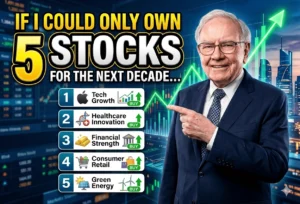
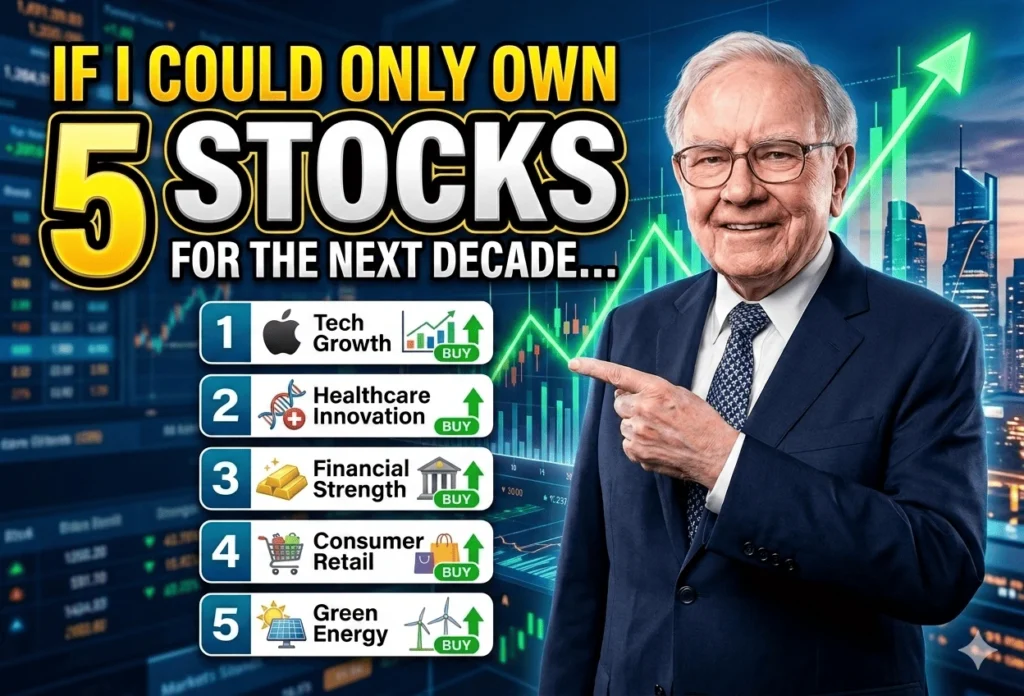
If I Could Only Own 5 Stocks, imagine the stock market were to close tomorrow and remain shuttered for the next ten years. In such a scenario, the “flashy” names and speculative “moonshots” lose their appeal. What remains valuable are durable, cash-generating businesses capable of compounding capital through multiple economic cycles. For a senior equity analyst, these are “Core Holdings.” To qualify for this designation, a company must demonstrate durable revenue growth, expanding or resilient margins, strong free cash flow (FCF), manageable debt levels, and a formidable long-term competitive moat.
The following five companies represent a disciplined approach to wealth accumulation, prioritizing robust balance sheets and dominant market positions that can withstand recessions, interest rate cycles, and shifts in the technological landscape.
If I Could Only Own 5 Stocks
1. Amazon (AMZN): The Multi-Engine Growth Powerhouse
Amazon has evolved far beyond its origins as an e-commerce platform. It is a diversified giant with multiple internal growth engines that provide powerful operating leverage. While the stock has lagged the broader market recently—up roughly 40% over the last five years compared to the S&P 500’s 80%—this underperformance highlights a forward-looking value opportunity rather than a fundamental weakness.
- AWS (Amazon Web Services): As the world’s premier cloud infrastructure platform, AWS is the critical backbone for the global shift toward AI-driven demand.
- High-Margin Advertising: A rapidly scaling segment that continues to be overlooked by the broader market, contributing significantly to bottom-line growth.
- Logistics & AI Infrastructure: Following an aggressive multi-year investment cycle in its physical and digital backbone, Amazon is now seeing these expenditures translate into significant margin expansion.
- Accelerating Operating Income: The transition from a heavy investment phase to a harvest phase means operating income is accelerating as the company optimizes its global retail scale.
- If I Could Only Own 5 Stocks
2. Alphabet (GOOGL): The AI-Integrated Cash Machine
Alphabet remains a foundational holding for any 10-year horizon. Despite concerns over AI competition, Alphabet is strengthening its product ecosystem through AI integration, not weakening it. Over the past five years, the stock has been dominant, rising nearly 200% compared to the S&P 500’s 80% gain.
Alphabet’s Free Cash Flow Profile: The company recently generated $73 billion in free cash flow (FCF), a figure achieved after accounting for massive capital expenditures. Alphabet maintains a pristine balance sheet and continues to buy back shares at an aggressive clip, trading at a valuation that suggests a mature, slow-growing company—a clear disconnect from its actual growth trajectory.
- Diversified Revenue Streams: Dominance in global Search, the advertising powerhouse of YouTube, and the steady growth of Google Cloud provide a safety net; if one segment slows, others provide offset.
- Moonshot Optionality: Alphabet’s driverless car business, Waymo, provides long-term optionality and internal diversification, even as it moves toward profitability.
- Aggressive AI CapEx: Alphabet’s commitment to AI leadership is evidenced by its CapEx trajectory:
- Two years ago: $32 billion
- Past year: $90 billion
- 2025 Projection: Upwards of $180 billion
- If I Could Only Own 5 Stocks
3. AbbVie (ABBV): The Dividend and Healthcare Anchor
To balance a portfolio heavy in technology, healthcare exposure is essential for income durability. AbbVie serves as a defensive anchor, offering a blend of growth and reliable capital return. Over the past five years, the stock has delivered a total return of nearly 170%, far outstripping the S&P 500’s gain of less than 100%.
- Post-Humira Transition: AbbVie has successfully navigated patent cliffs for its former flagship drug by building a diversified pharmaceutical pipeline and establishing next-generation revenue drivers.
- Dividend Reliability: The company pays an annual dividend of $6.92 per share, yielding approximately 3%.
- Consistent Growth: AbbVie has increased its dividend for 12 consecutive years—every year since it became an independent public entity.
- Strategic Balance: Provides strong cash flow and healthcare sector insulation, which is critical for maintaining stability during volatile market cycles.
4. Walmart (WMT): The Defensive Growth Engine
In uncertain economic environments, Walmart provides a rare combination of defensive strength and surprising capital appreciation. It is a dominant force that gains market share when consumers are under pressure. Its performance is a testament to its durability: the stock has gained roughly 200% over the last five years, doubling the broader market’s return.
- Grocery Dominance: As a staple of American household spending, Walmart’s grocery segment provides unparalleled traffic consistency.
- E-commerce Expansion: An aggressively growing digital business that complements its massive physical footprint and improves market structure.
- Margin Expansion: Despite its reputation as a low-cost leader, Walmart’s margins are expanding as it optimizes its logistics and delivery networks.
- Resilience: The business model is built to thrive across economic cycles, making it a vital component of a decade-long strategy.
5. Apple (AAPL): The Ultimate Consumer Ecosystem
Apple’s investment thesis centers on an unparalleled ecosystem that fosters extreme customer loyalty. While valuation has been a point of contention recently, Apple’s stability, capital return, and brand moat make it nearly impossible to replace in a core portfolio. Over the last five years, its 125% total return has significantly surpassed the S&P 500.
- Services Revenue Shift: Apple’s Services segment (icloud, App Store, Music) carries significantly higher margins than hardware. This recurring revenue stream is becoming a “bigger and bigger piece of the overall pie,” as seen in recent revenue distributions.
- Massive Free Cash Flow Growth: Apple’s ability to generate cash is staggering. A decade ago, the company generated $53 billion in FCF; over the trailing 12 months, that figure has surged to $123 billion.
- Shareholder Yield: Apple consistently returns this capital to shareholders through a combination of dividends and the most aggressive share buyback program in corporate history.
- Hardware Synergy: The integration between iPhone, Mac, iPad, and wearables creates a “sticky” ecosystem that ensures long-term revenue predictability.
Macro Analysis: Dominant Industry Trends for the 2030s
These five holdings are strategically positioned to capitalize on the structural shifts of the next decade:
- AI Integration & Cloud Dominance: Amazon, Alphabet, and Apple are not just participants in the AI shift; they are the architects. By integrating AI into their existing ecosystems, they strengthen their moats rather than being disrupted by them.
- The Resilient Consumer: Walmart and Apple represent the “must-have” components of consumer spending. Whether it is essential groceries or the central device of a digital life, these companies own the relationship with the customer.
- Capital Return and Macro Resilience: These companies are comfortable holdings through recessions and rate cycles. With strong balance sheets and consistent dividends (particularly ABBV and AAPL), they reward patient investors even when the broader market is sideways.
Investor FAQ: Navigating the Next Decade
1. What defines a “core holding” for a 10-year portfolio? A core holding is a business with durable revenue growth, resilient margins, strong free cash flow, manageable debt, and a dominant competitive moat that can withstand multiple economic cycles.
2. Why include Amazon if it has underperformed the S&P 500 recently? Amazon’s underperformance is a result of a massive investment cycle in logistics and AI infrastructure. As this cycle matures, operating income is accelerating and margins are expanding, making it a premier forward-looking play.
3. How much is Alphabet spending on AI infrastructure? Alphabet has scaled its CapEx from $32 billion two years ago to $90 billion this past year. It is projected to reach upwards of $180 billion by 2025 as it secures its position as an AI leader.
4. Is AbbVie a safe dividend stock after the Humira patent cliff? Yes. AbbVie has successfully diversified its pharmaceutical pipeline to build next-generation revenue drivers and has increased its dividend every year of its existence as a public company.
5. Why is Walmart considered a growth stock and not just a defensive play? While defensive, Walmart’s 200% gain over five years—driven by e-commerce expansion and market share gains—proves it can deliver growth that rivals tech sectors.
6. What is the significance of Apple’s Services revenue? Services revenue is higher-margin and recurring. It is becoming a larger portion of Apple’s total revenue, improving the overall quality and predictability of the company’s earnings.
7. How does Free Cash Flow (FCF) differ from Operating Cash Flow? FCF is the cash a company generates after accounting for capital expenditures (CapEx). It is calculated as Operating Cash Flow minus CapEx.
8. Why is diversification within a single company valuable? In companies like Alphabet and Amazon, internal diversification (Search, Cloud, Ads, Retail) ensures that if one segment faces a temporary headwind, the others can maintain the company’s growth trajectory.
9. Are these stocks “recession-proof”? No stock is entirely recession-proof, but these five possess the balance sheets and market dominance to remain comfortable holdings through recessions and interest rate cycles.
10. Does valuation matter when buying for a 10-year horizon? Yes. Even the best companies can be poor investments if purchased at an irrational price. Valuation and free cash flow analysis remain critical even for long-term core holdings.
Conclusion: Discipline Over Prediction
The combination of Amazon, Alphabet, AbbVie, Walmart, and Apple provides comprehensive coverage across Cloud Infrastructure, AI Integration, Healthcare, Defensive Retail, and Consumer Ecosystems.
If the market were to close for the next decade, these five specific moats—Amazon’s logistics, Alphabet’s search dominance, AbbVie’s healthcare patents, Walmart’s grocery leadership, and Apple’s hardware-software ecosystem—ensure that an investor would wake up wealthier on the other side. Long-term investing is not about chasing the highest immediate upside; it is about the discipline to own businesses that compound steadily through every economic environment. By focusing on free cash flow and durable competitive advantages, you build wealth that lasts.