1. The Perfection Trap: From Analysis Paralysis to Action Paralysis
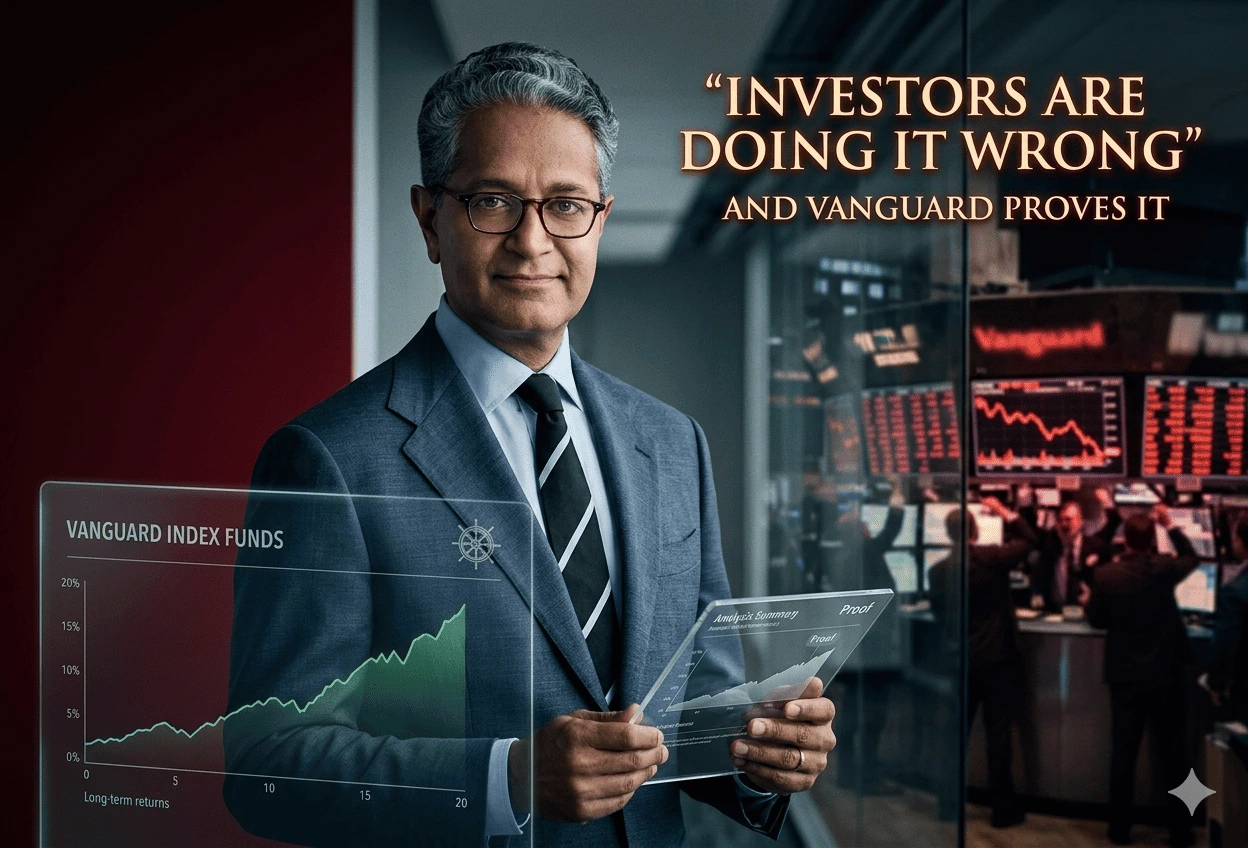
Investors are doing it wrong, in the high-stakes world of wealth management, investors frequently succumb to the “Perfection Trap.” We see clients and DIY investors alike obsessing over whether a 65/35 or a 70/30 equity-to-bond split is the definitive master key to financial security. This granular focus often leads to “Analysis Paralysis,” where the search for a theoretically optimal mix distracts from the variables that actually drive terminal wealth outcomes.
Vanguard’s research, spanning nearly a century of market history, serves as the definitive “ground truth” for this debate. The data reveals a sobering reality: while asset allocation is the primary driver of returns, the marginal utility of increasing equity exposure begins to diminish when adjusted for behavioral risk. The central thesis of any durable investment strategy must be that emotional durability—the ability to remain invested during market dislocations—matters significantly more than a 5% shift in portfolio construction.
Investors are doing it wrong
2. The Data Breakdown: Diminishing Marginal Utility in Returns
When reviewing historical performance, the immediate instinct is to solve for the highest average annual return. However, as a strategist, one must look past the headline percentage to the actual dollar outcome and the risk required to achieve it.
The following table illustrates the projected outcomes for an investor contributing $500 per month for 30 years (totaling $180,000 in principal contributions), based on Vanguard’s historical asset class data.
| Portfolio Type | Avg. Annual Return | Ending Balance | Risk/Reward Profile |
| 60/40 Portfolio | 8.8% | ~$878,000 | Balanced / Moderate |
| 80/20 Portfolio | 9.7% | ~$1.0 Million | Growth / High Volatility |
| 90/10 Portfolio | 10.1% | ~$1.2 Million | Aggressive / Maximum Drawdown |
From an analytical perspective, notice the transition from an 80/20 to a 90/10 mix. This shift provides a mere 0.4% return premium. While this results in a nominally higher ending balance, the strategist must ask: Is the marginal gain worth the asymmetric risk? For most, a 0.4% difference is not a “make-or-break” financial event, yet the psychological toll of the required volatility often leads to catastrophic behavioral errors.
Investors are doing it wrong
3. The Hidden Cost: Asymmetric Risk and Extended Recovery
Higher returns are never “free”; they are purchased with the currency of volatility. The relationship between risk and reward is non-linear—each incremental step toward an all-stock allocation requires accepting disproportionately deeper drawdowns.
Historical Worst Calendar Year Losses & Recovery Context:
- 60/40 Portfolio: ~27% decline. (Moderate recovery period).
- 80/20 Portfolio: ~35% decline. (Extended recovery period).
- All-Stock Portfolio: >40% decline. (Protracted recovery; high risk of “Action Paralysis”).
Warning: The “Drawdown Profile” of a portfolio is the ultimate test of an investment plan. You are not simply accepting a “little more” movement for a “little more” gain; you are accepting the potential for significant psychological pain for a relatively small increase in long-term growth. When the market tumbles, the recovery period for aggressive portfolios is often extended, testing the conviction of even the most seasoned investors.
Investors are doing it wrong
4. Vanguard’s Core Portfolio Archetypes
Rather than focusing on decimal-point optimization, Vanguard categorizes portfolios by their functional mandate. Aligning your capital with the correct archetype ensures the portfolio serves your life stage rather than a spreadsheet ideal.
- Income Portfolios
- Mandate: Stability, cash flow, and principal preservation over growth.
- Characteristics: High bond concentration to mitigate large swings; designed for near-term liquidity needs.
- Growth Potential: Approximately 5% (Historical bond-heavy average).
- Balanced Portfolios
- Mandate: A “smoother ride” that blends accumulation with capital protection.
- Characteristics: Mitigates extreme volatility while allowing for inflation-beating growth.
- Growth Potential: Approximately 7% to 8% annually.
- Growth Portfolios
- Mandate: Long-term wealth maximization where volatility is the “price of admission.”
- Characteristics: Heavy equity tilt; requires a multi-decade horizon to absorb deep drawdowns.
- Growth Potential: Approximately 9% to 10%+ annually.
5. Macro Analysis: Emotional Durability vs. Theoretical Variance
Precision in asset allocation matters far less than the market would have you believe. In a vacuum, a 1% shift in equity exposure is noise. In reality, the deciding factor is “Emotional Durability”—the ability to withstand a 40% decline without abandoning the strategy.
Consider the shift from “Theoretical Optimization” to “Real-Life Survival.” A 40% drawdown on a $15,000 portfolio is a $6,000 setback—uncomfortable, but easily survivable for an investor in their 30s with a steady income. However, that same 40% drop on a $1.25 million portfolio represents a $500,000 loss.
For a retiree, this is not a temporary fluctuation; it is Sequence of Returns Risk. If a retiree is forced to sell assets to fund daily living expenses during such a drawdown, it results in the permanent impairment of capital. A high-return portfolio that you abandon during a crash is mathematically inferior to a lower-return portfolio you can actually hold through the storm.
6. The Vanguard Strategy: Five Directives for Success
To move beyond optimization and toward successful outcomes, adopt these five strategic commands:
- Define the Mandate: Explicitly state the purpose of the capital. Is it for immediate Income, long-term Legacy, or Liquidity/Peace of Mind?
- Calibrate Risk Tolerance: Assess your capacity for loss both emotionally (sleep-at-night factor) and financially (what your balance sheet can realistically absorb).
- Clock the Horizon: Determine exactly when the capital will be liquidated. Your “Time Horizon” is often a more critical variable than your retirement date.
- Execute Life-Aligned Allocation: Choose a mix that fits your specific requirements, ignoring headlines and theoretically “optimal” models designed for someone else’s life.
- Enforce Rebalancing: View rebalancing as a risk management tool, not a return-optimization tactic. It is a control mechanism to prevent accidental over-concentration and minimize emotional decision-making.
7. FAQ: Navigating Portfolio Volatility and Risk
1. Does a 1% difference in stock allocation really matter? No. Over 30 years, such minute changes are statistically insignificant compared to the impact of staying invested and maintaining low costs.
2. What is the historical return of a 60/40 portfolio? Historically, the 60/40 mix has delivered an average annual return of approximately 8.8%.
3. How much could I lose in a bad year with an all-stock portfolio? Data shows you should be prepared for a decline of 40% or more in a single calendar year.
4. Why is rebalancing necessary if it doesn’t “optimize” returns? Rebalancing is about maintaining your risk profile. Without it, a bull market will “drift” your portfolio into a higher equity weight than you can emotionally handle when the inevitable crash occurs.
5. What is the actual trade-off between an 80/20 and 90/10 portfolio? You gain roughly 0.4% in annual return (9.7% vs 10.1%) but must accept a jump from a 35% potential drawdown to a 40%+ drawdown.
6. Is a growth portfolio appropriate for an investor in their 70s? Generally, no, due to sequence of returns risk. However, if the portfolio is a “Legacy Mandate” intended for heirs with a 30-year horizon, a growth tilt may be appropriate.
7. What is “emotional durability” in a financial context? It is the psychological fortitude to ignore the “Action Paralysis” of a bear market, allowing the mathematics of compounding to function uninterrupted.
8. How do contributions compare to returns in building wealth? In our $1.2M example, the $180,000 in principal was the engine. Without the discipline of steady contributions, the return rate has no capital base to compound.
9. What is the primary objective of an income-focused portfolio? Capital preservation and cash flow. It prioritizes avoiding the “threat to survival” posed by large drawdowns.
10. Why is “staying invested” the most important factor in compounding? Compounding is a back-loaded process. If you exit the market during a downturn, you reset the clock and miss the recovery, often permanently stalling your wealth trajectory.
8. Conclusion: The Best Portfolio is the One You Can Keep
Nearly a century of Vanguard data reinforces a singular strategic truth: time in the market beats timing the market. While aggressive, high-equity portfolios look superior on a spreadsheet, they require a level of emotional durability that many investors overestimate until they are in the teeth of a bear market.
Asset allocation doesn’t determine how rich you get; it determines your ability to stay invested long enough to get there. Prioritize your psychological peace of mind over the pursuit of the final decimal point. The “optimal” portfolio is not the one with the highest theoretical return—it is the one you can hold onto through the inevitable storms.
Disclaimer: All investing carries risk. This report is for informational and educational purposes only and does not constitute financial advice. Past performance is not indicative of future results. Always perform individual research or consult with a qualified financial advisor before making investment decisions.