
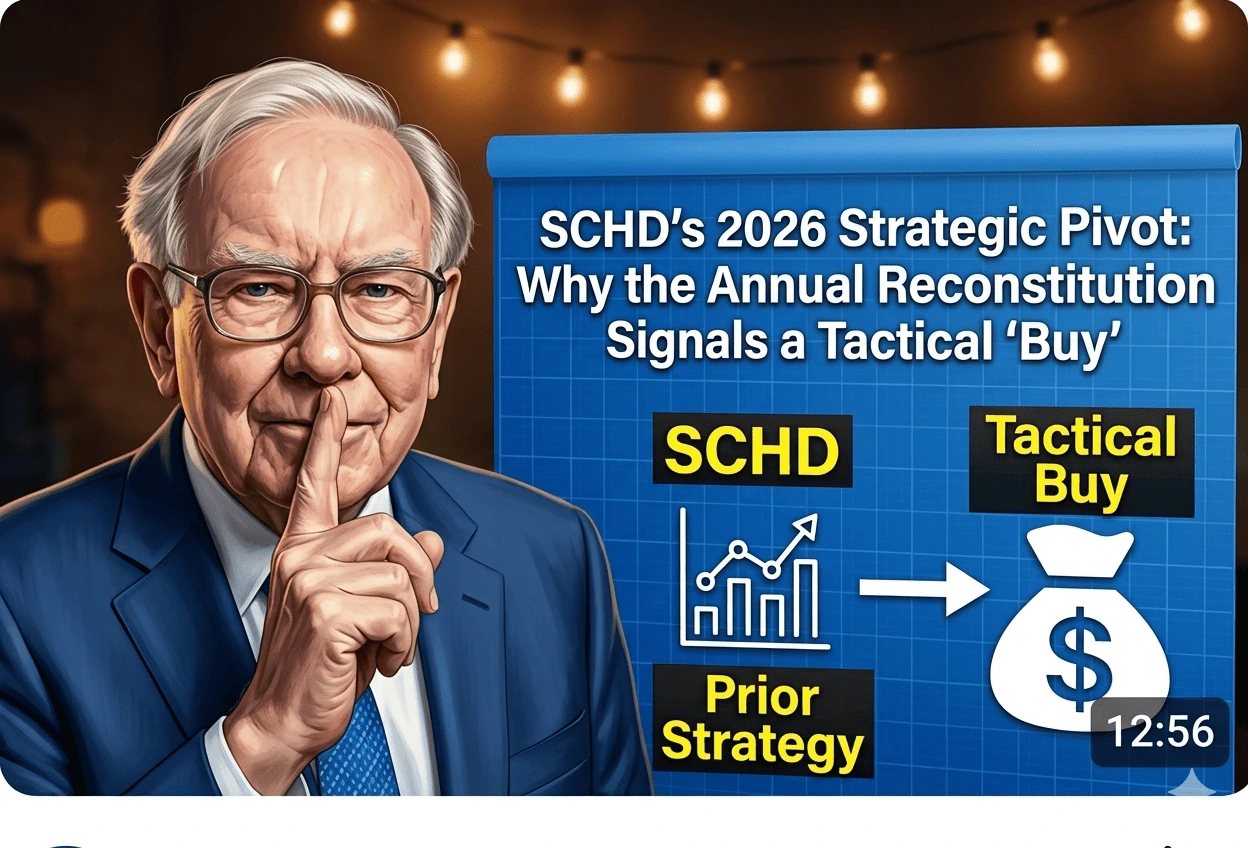
SCHD’s 2026 Strategic Pivot in a market environment defined by extreme divergence—where high-flying semiconductor names mask broader weakness in software and traditional growth sectors—institutional and retail investors alike are re-evaluating the role of stabilizers. For those heavily concentrated in “Magnificent Seven” names like Nvidia, Alphabet, and Microsoft, the Schwab U.S. Dividend Equity ETF (SCHD) has evolved from a simple income play into a critical portfolio hedge.
The catalyst for this renewed interest is the fund’s upcoming Annual Reconstitution. Commencing officially on March 20th, with the “New Look” portfolio beginning trade on March 23rd, this rebalancing represents a fundamental shift in the fund’s DNA. By algorithmically pivoting away from the volatile Energy sector and toward defensive anchors in Consumer Staples and Healthcare, SCHD is optimizing its risk-adjusted profile for a late-cycle economic environment. The thesis is clear: SCHD is not just a yield play; it is a tactical necessity for 2026.
SCHD’s 2026 Strategic Pivot
Macro Analysis: The Algorithmic Shift to Defensive Strength
The 2026 reconstitution is a proactive response to shifting macro realities. While energy prices experienced temporary spikes due to geopolitical instability in the Middle East, SCHD’s underlying algorithm is designed to capitalize on these movements by taking profits. This systematic approach removes human emotion, rotating capital into sectors better positioned for a “slower economic period.”
Historical data validates this defensive utility. In 2022, when the S&P 500 retracted 20% and aggressive growth names plummeted between 50% and 65%, SCHD remained nearly flat. This resilience is the direct result of the fund’s sector-weighting discipline, which is about to become even more robust.
Projected Sector Weighting Realignment
| Sector | Old Look (2024/2025) | New Look (Projected 2026) |
| Energy | 21% | 12% |
| Consumer Staples | 17% | 20% |
| Healthcare | 16% | 18% |
| Financials | ~11% | 15% |
Strategic Balance: Offensive vs. Defensive
This realignment creates a dual-threat portfolio. The expansion of Consumer Staples and Healthcare provides a defensive safety net, sectors that traditionally capture “flight-to-safety” capital during economic contractions. Simultaneously, the increased weighting in Financials and Industrials ensures the fund maintains “offensive” capabilities to capture upside should the domestic economy remain resilient.
SCHD’s 2026 Strategic Pivot
The Engine of SCHD: The Quality Algorithm
SCHD’s performance is dictated by a rigorous, rules-based “Quality Algorithm” rather than human intervention. This ensures the fund remains focused on fundamental solvency and cash flow. The algorithm filters the market to select the top 100 dividend-paying equities based on four non-negotiable financial pillars:
- Cash Flow to Total Debt: A measure of a company’s ability to service leverage and weather high-interest-rate environments.
- Return on Equity (ROE): Identifying management efficiency and underlying profitability.
- Dividend Yield: Ensuring immediate income generation for the fund.
- 5-Year Dividend Growth Rate: Assessing the sustainability and momentum of shareholder returns.
Analysis of the Core: The Top 10 Holdings
The following ten companies represent approximately 42% of the fund’s total weighting. This concentration reflects the algorithm’s high conviction in quality names that provide both defensive stability and reliable capital allocation.
- Lockheed Martin (Industrials): A cornerstone of the industrial weight, benefiting from sustained global defense spending and a massive contract backlog.
- ConocoPhillips (Energy): Represents the refined energy exposure; chosen for its disciplined capital return programs and low-cost production assets.
- Verizon (Communication Services): Acts as a high-yield, utility-like stabilizer with essential-service revenue streams.
- Chevron (Energy): A large-cap balance to commodity risk, prioritized for its robust balance sheet and long-term dividend reliability.
- Bristol-Myers Squibb (Healthcare): A key beneficiary of the healthcare expansion, offering defensive earnings through its diversified pharmaceutical pipeline.
- Merck & Co. (Healthcare): A healthcare leader with strong oncology tailwinds and a resilient cash flow profile.
- Altria Group (Consumer Staples): Provides high-yield defensive exposure; the algorithm favors its exceptional free cash flow generation.
- Texas Instruments (Information Technology): Offers technology exposure without the volatility of software, driven by its essential role in industrial and automotive semiconductors.
- Coca-Cola (Consumer Staples): The ultimate defensive play, utilized for its global scale and immense pricing power in inflationary environments.
- PepsiCo (Consumer Staples): Complements the staples sector with a diverse portfolio of food and beverage assets and a history of consistent annual dividend growth.
Comparative Analysis: Why SCHD is a “Notch Above”
Investors often weigh SCHD against peers like VIG (Dividend Appreciation) or HDV (High Yield). However, SCHD occupies a unique “Best of Both Worlds” quadrant, offering higher yields than growth-focused ETFs and higher growth than yield-focused ETFs.
Direct ETF Comparison
| Metric | SCHD | VIG / DGRO (Growth) | HDV / VYM (Yield) |
| Current Yield | ~3.5% | Lower (Tech-Heavy) | High Yield |
| Dividend Growth | ~10% (5-Yr) | Moderate | Lower |
| Tech Exposure | Moderate/Strategic | Very High | Low |
| Primary Driver | Quality Algorithm | Dividend Longevity | Current Income |
SCHD’s 14 consecutive years of dividend growth and 10% 5-year growth rate prove that it does not sacrifice appreciation for income—it synthesizes them.
SCHD’s 2026 Strategic Pivot
Investor Strategy: The Case for Immediate Entry
The recent performance data provides a compelling entry signal. While the S&P 500 has struggled to remain in the “green” year-to-date, SCHD has achieved a 12% YTD return. This outperformance is even more stark when compared to tech sub-sectors: the semiconductor ETF (SMH) is up only 2%, while the software-heavy IGV is down 14%.
Furthermore, over the last six months, SCHD has returned 15%, nearly quadrupling the S&P 500’s 4% return over the same period. For investors heavily weighted in volatile software or AI names, SCHD serves as “Diversification as an Offset.” It provides the psychological and financial floor necessary to prevent “bailing at the bottom” during 50%+ drawdowns in growth sectors, allowing for long-term patience and compounding.
SCHD’s 2026 Strategic Pivot
FAQ: Reconstitution and Strategy
When is the SCHD reconstitution date?
The official changes are codified on March 20th. The “New Look” SCHD begins its first day of trading on March 23rd.
Why is SCHD significantly reducing its Energy exposure?
The algorithm is essentially “taking profits.” Following the price spikes driven by Middle East tensions, the fund is rotating capital into more stable, higher-quality cash flow names in the Staples and Healthcare sectors.
Is SCHD a better investment than VIG or DGRO?
For investors who already have heavy tech exposure (via S&P 500 or QQQ), SCHD is often superior. While VIG and DGRO are quality funds, they are tech-heavy; SCHD provides a higher yield and faster dividend growth without over-concentrating in technology.
What are the four metrics used by the SCHD algorithm?
The fund selects its 100 holdings based on Dividend Yield, Dividend Growth, Free Cash Flow, and the Free Cash Flow to Debt Ratio.
How has SCHD performed relative to the S&P 500 recently?
SCHD has significantly outperformed in the short term, posting a 15% return over the last six months compared to just 4% for the S&P 500.
What percentage of the fund is in the top 10 stocks?
The top 10 holdings represent approximately 42% of the fund’s total weighting, indicating a concentrated bet on high-quality blue-chip equities.
Why is Consumer Staples becoming the top sector weighting?
The shift to a 20% weighting in Consumer Staples is a defensive hedge designed to protect capital during potential economic slowdowns while providing a “safety element” to the total portfolio.
Does SCHD help during market crashes?
Yes. During the 2022 bear market, SCHD was nearly flat while growth stocks like Tesla and Nvidia saw drawdowns of 50-65%, demonstrating its role as a portfolio stabilizer.
What is the 5-year dividend growth rate for SCHD?
The fund boasts a robust 5-year dividend growth rate of approximately 10%.
How many years has SCHD increased its dividend?
SCHD has achieved 14 consecutive years of dividend growth, affirming the sustainability of its systematic selection process.
SCHD’s 2026 Strategic Pivot
Conclusion: The 2026 Outlook
The transition of SCHD into its “New Look” 2026 profile marks a strategic pivot toward defensive durability without sacrificing offensive potential. By curbing Energy exposure and bolstering Financials, Staples, and Healthcare, the fund is positioning itself for a superior risk-adjusted performance cycle.
For the disciplined investor, the current 12% YTD outperformance against a faltering S&P 500 is not an anomaly—it is a proof of concept. As the market prepares for the official changes on March 20th, SCHD remains a core tactical holding for those seeking to balance aggressive growth with algorithmic stability.