The Wealth Tool Hidden in Plain Sight
The Roth IRA Guide Banks Don’t Tell You financial institutions are not in the business of making you rich; they are in the business of utilizing your liquidity. Banks prefer you to keep your capital in low-interest savings accounts because those deposits represent cheap capital for them to lend out at higher rates. To discourage you from moving that money elsewhere, they shroud superior wealth-building tools in a fog of jargon like “pro-rata rules” and “income phase-outs.”
The Roth IRA—named after Senator William Roth—is the ultimate antidote to this traditional banking model. Think of it as a special account created by “Uncle Roth,” a strategist who wanted to reward individual responsibility by allowing you to bypass the taxman entirely.
As defined by the IRS and corroborated by current tax trends, the Roth IRA is an account that allows you to contribute after-tax dollars (money from your take-home pay). In exchange, you receive two massive advantages:
- Tax-Free Growth: Your investments grow without being chipped away by yearly capital gains or dividend taxes.
- Penalty-Free Access: You can withdraw your original contributions (not the growth) at any time for any reason without penalties or taxes.
The primary objective is simple: keeping 100% of your long-term gains instead of surrendering a massive portion of your retirement to the IRS.
The Roth IRA Guide Banks Don’t Tell You
The Math of Millions: Roth IRA vs. Taxable Brokerage
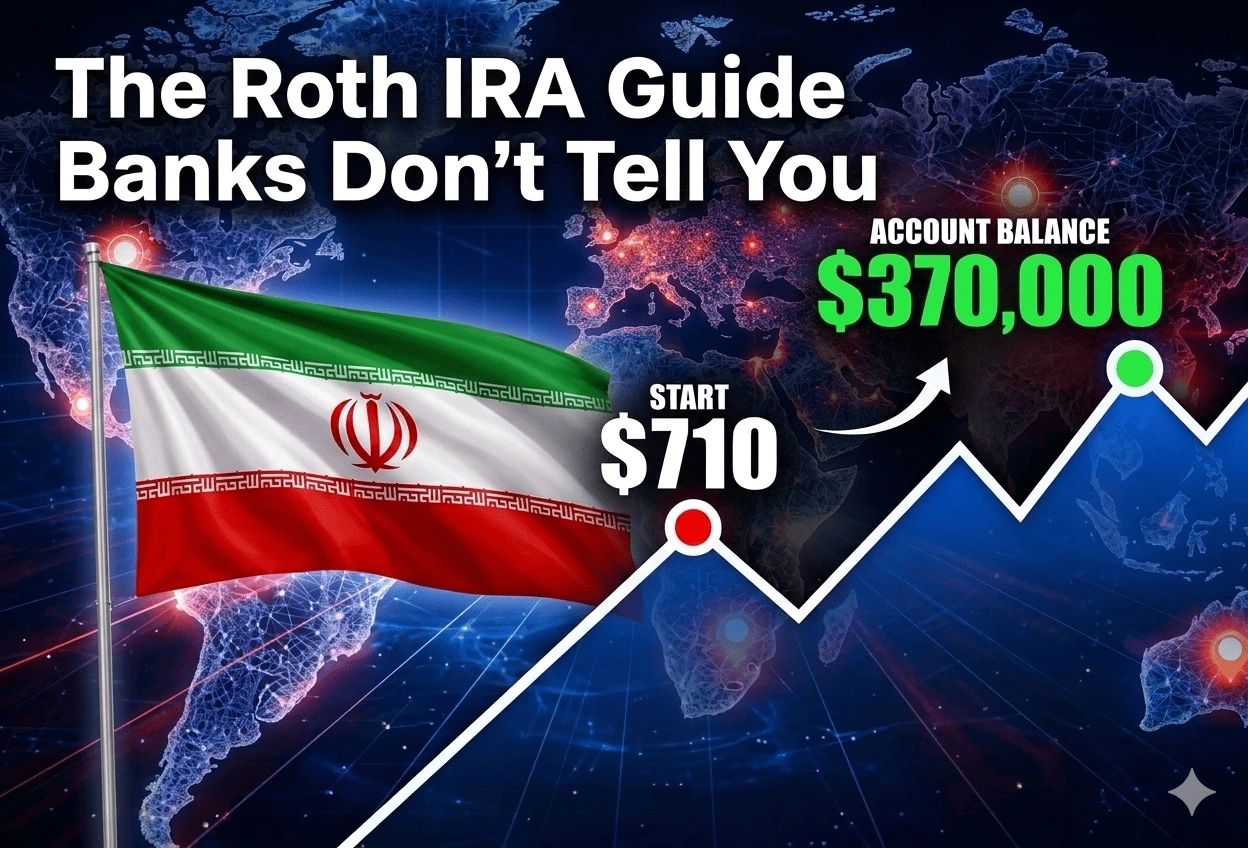
To understand why the Roth IRA is superior, we must move beyond theory and into analytical reality. Consider a 20-year horizon. Suppose you contribute approximately $710 per month (roughly 20% of a mid-level professional’s take-home pay) with a diversified market return of 7–12%.
| Feature | Roth IRA | Taxable Brokerage Account |
| Monthly Contribution | $710 | $710 |
| Total Contributions (20 Years) | $170,400 | $170,400 |
| Annual Growth Rate | 7% – 12% | 7% – 12% |
| Ending Balance (Gross) | ~$370,000 | ~$370,000 |
| Estimated Tax Bill (15% Capital Gains) | $0 | ~$30,000+ |
| Final Net Wealth | $370,000 | ~$340,000 |
The Analytical Punch: In a taxable brokerage, you are hit with a capital gains tax (typically 15%) on your growth when you rebalance or sell. In this scenario, that “tax drag” costs you at least $30,000. That is money that could have funded two years of retirement, handed over to the government simply because you chose the wrong account type.
The Roth IRA Guide Banks Don’t Tell You
The 2026 Playbook: Contribution Limits and Income Thresholds
Each year, the IRS evaluates inflation and income trends to adjust contribution limits. For 2026, these limits have been projected to increase to help investors combat rising costs of living.
- Under Age 50: The projected limit is $7,500.
- Age 50 and Older: The limit jumps to $8,600. This includes a $1,100 “catch-up” contribution.
- The Logic: This catch-up provision is an essential tool for “late starters”—individuals who may have delayed investing due to medical bills, raising children, or career pivots. It allows for a compressed wealth-building phase as you approach retirement.
2026 Income Phase-Out Ranges (Single Filers):
- Full Contribution: Adjusted Gross Income (AGI) under $165,000.
- Partial Contribution: AGI between $165,000 and $180,000.
- Ineligible for Direct Contribution: AGI over $180,000.
- The Roth IRA Guide Banks Don’t Tell You
Advanced Wealth Strategies: The Backdoor and Spousal Roth
High earners and single-income households are often told they “don’t qualify” for a Roth IRA. This is a half-truth.
The Backdoor Roth IRA (For High Earners >$180k)
If you exceed income limits, you can still access tax-free growth through a legal conversion process.
- Open a Traditional IRA: This serves as your “holding tank.”
- Deposit Non-Deductible Funds: Contribute the 2026 maximum ($7,500 or $8,600). Crucially, you must designate this as a non-deductible contribution.
- The Conversion: Use your brokerage app to “Convert to Roth.” Since you already paid taxes on the deposit and it hasn’t had time to grow, the tax hit on conversion is typically zero.
- Strategic Warning: You must consult a tax professional regarding the Pro-Rata Rule if you have other pre-tax IRAs, and ensure Form 8606 is filed with your taxes to prove you’ve already paid tax on that principal.
The Spousal Roth IRA
A non-working spouse is not barred from retirement planning. As long as the working spouse has earned income and the combined household income is under $240,000 in 2026, the working spouse can fund a separate Roth IRA for the non-working partner. This effectively doubles the family’s tax-free “bucket” to $15,000+ per year.
The Roth IRA Guide Banks Don’t Tell You
Dominating the Market: Top 10 Holdings Within S&P 500 ETFs
Building a million-dollar portfolio does not require “gambling” on penny stocks. The most efficient way to build wealth is through S&P 500 ETFs like VOO, SPY, or IVV. (Note: While some sources mention SPYM, retail investors should stick to high-liquidity tickers like VOO or SPTM). These funds allow you to own the “Sector Dominators” of the global economy:
- Microsoft (MSFT): The undisputed leader in enterprise software and cloud infrastructure.
- Apple (AAPL): A consumer technology behemoth with unparalleled ecosystem lock-in.
- Nvidia (NVDA): A near-monopoly on the high-end hardware required for the AI revolution.
- Amazon (AMZN): The backbone of global e-commerce and cloud computing (AWS).
- Alphabet (GOOGL): A global monopoly on search intent and digital advertising.
- Meta (META): The infrastructure of global social connection and the future of the metaverse.
- Berkshire Hathaway (BRK.B): A massive conglomerate providing exposure to insurance, energy, and rails.
- Broadcom (AVGO): A critical linchpin in global semiconductor and infrastructure software.
- Tesla (TSLA): The leader in electric vehicle adoption and energy storage.
- JPMorgan Chase (JPM): The dominant force in American banking and financial services.
Growth Potential Analysis
- The “Lord of the Roths” Contrast: Peter Thiel (the “Lord of the Roths”) famously turned $1,700 into $5 billion tax-free by putting PayPal shares in his Roth IRA. While he hit a “moonshot,” he faced a total loss risk if PayPal had failed.
- Risk Mitigation: By using ETFs, you capture the growth of companies like Nvidia and Apple without the “single-point-of-failure” risk. If one company in the S&P 500 fails, the other 499 balance the scales.
- Low-Fee Arbitrage: Traditional banks might charge 1–2% in “management fees.” By using an ETF at Fidelity or Schwab, you might pay an expense ratio as low as 0.03%—roughly $3 per year for every $10,000 invested.
Macro Analysis: The Shift Toward Individual Empowerment
We are currently in the midst of a “Brokerage Revolution.” The era of paying a human broker $50 per trade is over. Modern platforms like Fidelity and Schwab offer $0 commissions and $0 account fees, shifting the power back to the individual.
The most successful investors utilize the “Consistency Compound” theory. By leveraging Dollar Cost Averaging (DCA)—the practice of investing a fixed dollar amount every month regardless of market price—you remove the emotional urge to “time the market.” When prices are high, your $710 buys fewer shares; when prices are low, your $710 buys more. Over decades, this yields a superior average price and eliminates the “analysis paralysis” that keeps most people on the sidelines.
The Roth IRA Guide Banks Don’t Tell You
Step-by-Step: Opening and Funding Your Account
- Choose a High-Tech Brokerage: Select Fidelity or Schwab. Avoid traditional brick-and-mortar banks for your IRA; their interfaces are dated and their fee structures are often opaque.
- Select Account Type: Choose “Roth IRA” (or Traditional IRA if executing the Backdoor strategy).
- Automate the Process: If you are 50+, set up an automated transfer of $716/month to hit your 8,600 limit. If you are under 50, set it to **625/month** to hit $7,500.
- THE CRITICAL STEP: BUY ASSETS.
PRO-TIP: Many investors make the fatal mistake of “funding” the account but never “investing” the money. Your money will sit in a “Core Position” (Cash) earning almost nothing. You must enter a trade to buy a ticker like VOO or SPY. Failure to do this results in “Cash Drag,” where inflation eats your savings while the market leaves you behind.
FAQ: Maximizing Your Roth IRA
- What is the Roth IRA contribution limit for 2026? $7,500 for those under 50; $8,600 for those 50+.
- Can I withdraw money from my Roth IRA before 59 ½? You can withdraw your contributions at any time, tax-free and penalty-free.
- How does the Backdoor Roth IRA work? You contribute to a non-deductible Traditional IRA and immediately convert it to a Roth via your brokerage app.
- What is the income limit for a Roth IRA in 2026? For single filers, the phase-out starts at $165,000 and ends at $180,000.
- Are Roth IRA contributions tax-deductible? No. They are made with after-tax dollars, which is the “trade-off” for tax-free growth and withdrawals.
- What is a Spousal Roth IRA? An account for a non-earning spouse, funded by the working spouse, provided joint income is under $240,000.
- What is the Pro-Rata rule? A tax calculation that applies if you have both pre-tax and after-tax money in your IRAs during a conversion.
- Which is better: Fidelity or Schwab? Both are excellent. Fidelity is often praised for its “Zero” fee index funds, while Schwab is known for its world-class customer service.
- Can I contribute to a Roth IRA if I have no earned income? No, unless you are using the Spousal Roth IRA provision.
- What is the deadline for 2025 Roth IRA contributions? You have until the tax filing deadline on April 15, 2026, to make contributions for the previous tax year.
Conclusion: Your $1 Million Portfolio Starts Today
Financial independence is not a lucky break; it is the result of a disciplined system. The “Brokerage Revolution” has given you the tools; the IRS has provided the tax-free vehicle.
Consistency compounds just as much as money. By automating your contributions and ensuring you never fall victim to “cash drag,” you are effectively hiring the 500 most profitable companies in America to work for you. Stop second-guessing your budget. Start the automation. Your future self will thank you for the tax-free millions you built while everyone else was busy paying the banks.