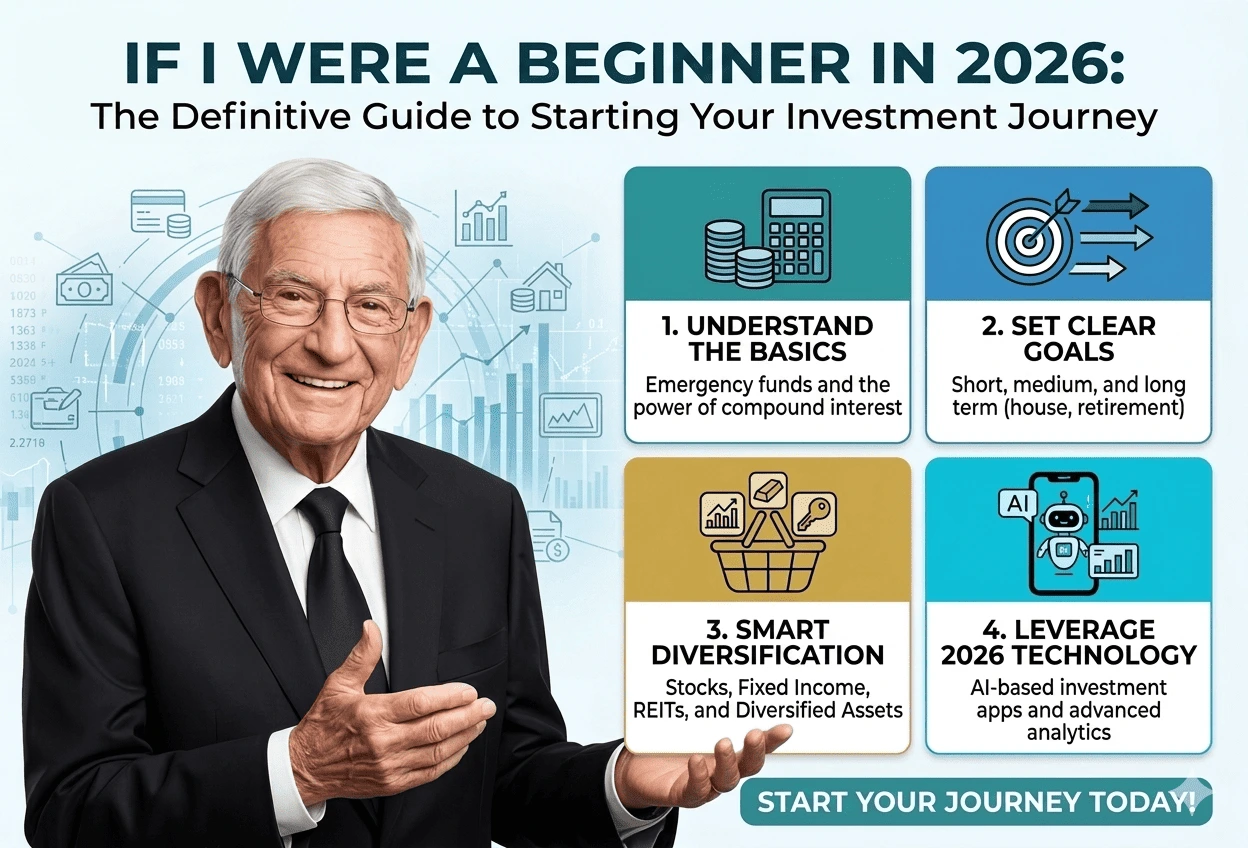
If I were a beginner in 2026, in the financial landscape of 2026, the greatest risk to your wealth is not market volatility—it is inertia. For the uninitiated, the world of ticker symbols and market orders can feel like a foreign language, yet remaining on the sidelines is an active choice to let your purchasing power erode. Wealth preservation and accumulation in this era require a fundamental shift from speculative timing to systematic exposure.
To understand the urgency, look no further than the “Chipotle Burrito” index. In 2019, a standard burrito cost approximately $8.50. By 2026, that cost has surged toward $12.00. If you held $50,000 in a stagnant checking account in 2019, you could have purchased 5,882 burritos. Today, that same capital buys only 4,166—a “loss” of 1,700 burritos to inflation. With the Federal Reserve targeting a 2–3% annual inflation rate, cash is a melting ice cube. To achieve true financial freedom, you must target the historical 8–10% annual returns of the equity markets. This is your roadmap.
Macro Analysis: Why the “Wait and See” Strategy Fails
Market psychology often traps beginners into the “all-time high” fallacy—the belief that because the market is at a record level, a crash is imminent. History tells a different story.
The Cost of Market Timing
The S&P 500 spends approximately 8.3% of all trading days at all-time highs—roughly 21 days per year. More importantly, record highs are frequently the precursor to further highs. Missing the “best days” in the market is mathematically devastating. Over the last 30 years, missing just the 10 best trading days would have erased 54% of your total gains. Missing the 30 best days results in an 83% loss in total returns. Time in the market is a mathematical necessity; timing the market is a fool’s errand.
The 2012 Overvaluation Lesson
Consider the “expert” consensus in 2012, when many claimed the market was 50% overvalued while the S&P 500 sat at the 1,400 level. Those who waited for a “correction” missed a massive bull run; the market is now nearly 4.5x higher than those 2012 levels.
The Individual Stock Trap: Intel vs. The Index
While individual stocks offer allure, they carry idiosyncratic risk. In 2000, INTC (Intel) reached a high of $72 per share. Twenty-six years later, an investor in Intel would still not have recouped their initial capital. In that same period, the S&P 500 index returned more than four times the original investment. This is why a “Senior Strategist” approach prioritizes indices over individual guesses.
Price Tags and P/E Ratios
We measure value using the Price-to-Earnings (P/E) Ratio. Think of this as the “price tag” of a stock relative to its profits. While high P/E ratios are correlated with lower 5-year returns, research from Nick Maggiulli confirms that over 20- to 30-year horizons, these returns converge. Over any 30-year period, U.S. market returns have generally converged to positive territory regardless of the entry price’s “dispersion.”
If I were a beginner in 2026
Core Holdings: 8 Entities Dominating the 2026 Market
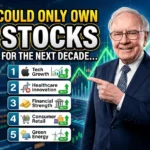
For the 2026 beginner, success is found in owning the primary engines of the U.S. economy.
1. VOO (Vanguard S&P 500 ETF) The “Lead Entity” and the bedrock of any sophisticated portfolio. This ETF provides instant diversification across the 500 largest U.S. companies.
- Set and Forget: Automatically tracks the index with near-zero management fees.
- Systemic Growth: Captures the aggregate innovation of the American economy.
2. NVIDIA (NVDA) A high-reward component that represents the infrastructure of modern computation.
- Growth Potential: Significant reward-for-risk profile compared to the broader index.
- Market Leader: Dominates the semiconductor space essential for 2026 technology.
3. Apple (AAPL) The quintessential foundational individual stock for any retail portfolio.
- Cash Flow King: Unparalleled consumer ecosystem and balance sheet strength.
- Stability: Acts as a stabilizing force within the tech-heavy index.
4. Microsoft (MSFT) A dominant force in enterprise software and cloud infrastructure.
- Institutional Choice: A primary holding for almost every major pension and mutual fund.
- Diversified Revenue: Multiple moats across software, gaming, and cloud services.
5. Tesla (TSLA) A key component of modern diversification, offering exposure to energy and autonomous sectors.
- High Volatility/High Reward: Provides the growth “tilt” necessary for long-term outperformance.
- Innovation Engine: Leads the transition to sustainable energy infrastructure.
6. Alphabet/Google (GOOGL) The staple of the digital information economy.
- Monopoly-Like Moat: Essential infrastructure for global advertising and search.
- AI Integration: Deeply embedded in the next wave of technological scaling.
7. Meta (META) A top-tier diversification play focusing on global social communications.
- Unmatched Scale: Controls the primary attention economy for billions of users.
- Data Dominance: High margins driven by sophisticated ad-targeting capabilities.
8. Coca-Cola (KO) The liquid “Blue Chip” counterbalance to tech-heavy volatility.
- Liquidity Advantage: Unlike a $500,000 house which may take 30+ days to sell, KO can be liquidated for cash in seconds.
- Predictable Returns: Provides stability and dividends, performing a defensive role in the portfolio.
9. Nasdaq-100 (QQQ) A tech-focused supplement that tracks the 100 largest non-financial companies.
- Innovation Focus: Offers a more concentrated bet on growth and technology than VOO.
- Efficiency: Automatically filters out slower-growing financial institutions.
Strategic Methodology: How to Invest the Dollars
| Strategy | Definition | Risk Mitigation |
| Lump Sum | Investing all available capital immediately. | Reduces the opportunity cost of holding cash. |
| Dollar Cost Averaging (DCA) | Investing a fixed amount (e.g., $500/mo) regardless of price. | Lowers the average cost per share during periods of high volatility. |
The “Just Keep Buying” Philosophy
Success is not about the “perfect” entry; it is about the “consistent” entry. The most effective strategy for the 2026 investor is to automate. When prices are high, your fixed dollar amount buys fewer shares; when prices are low, you “collect” more shares. Over time, your cost averages out, removing the psychological paralyzation of market peaks.
Leverage and Compound Interest
The mechanics of wealth are scale-dependent. A 10% return on $1,000 is a mere $100—helpful, but not transformative. However, that same 10% return on $1,000,000 is $100,000 in passive income. By starting early, you use time as leverage to move from small-scale returns to life-changing compounding.
If I were a beginner in 2026
The Logistics: Accounts and Execution
Account Selection
- Retirement Accounts (401k/IRA): These are tax-advantaged vehicles. The government provides incentives to keep money here until retirement age—a form of “forced savings.”
- Regular Brokerage Accounts: These offer total liquidity. You can sell and withdraw cash at any time, though you will owe taxes on the capital gains.
Platform Selection
I recommend Fidelity, Charles Schwab, or Robinhood. While Vanguard is a reputable nonprofit firm, its user interface is often cumbersome for beginners. Modern platforms like Robinhood allow for Automated Recurring Investments, enabling you to buy Fractional Shares (investing in dollars, e.g., $10 of a $600 stock) on a daily, weekly, or bi-weekly basis.
The Language of Wall Street
- Ticker Symbols: Think of these as “airport codes.” Apple is AAPL (JFK), Microsoft is MSFT (LHR), and the S&P 500 is VOO.
- Market Orders: An instruction to buy immediately at the current “sticker price.”
- Limit Orders: An instruction to buy only at a maximum price or lower (e.g., “Buy VOO only if it hits $600″).
The Beginner’s Checklist for 2026
- Step 0: Establish Consistent Income. If you only have $1,000 to your name, invest in yourself first. Skills yield higher immediate returns than the market.
- Step 1: Define the “Why.” Acknowledge that you are investing to outpace the 2–3% inflation target and capture 8–10% market growth.
- Step 2: Open the Account. Select Fidelity, Schwab, or Robinhood.
- Step 3: Deploy into VOO. For most, a broad index fund is the most consistent path to the millionaire mark.
- Step 4: Automate. Set a recurring buy (e.g., 100–200/month) to remove emotion from the equation.
- If I were a beginner in 2026
Frequently Asked Questions
- What does ETF stand for? Exchange-Traded Fund. It is a basket of stocks that trades on the exchange just like an individual company.
- Market or Limit order? Use a market order for immediate execution. Use a limit order to specify a maximum price you are willing to pay.
- Is it too late to invest at all-time highs? No. History shows that 20-year horizons have yielded zero negative real returns, regardless of whether you started at a peak.
- How much do I need to start? If you have consistent income, start with as little as 100–200 per month (the strategy used on a $55k salary).
- Mutual Fund vs. Index Fund? Mutual funds are often actively managed for a high fee. Index funds automatically track a list (like the S&P 500) for significantly lower costs.
- Why is the S&P 500 “safe”? It provides instant diversification across 500 companies; your success is tied to the U.S. economy, not a single business failure.
- What is a P/E ratio? A “price tag” showing how much you pay for every $1 of a company’s earnings.
- What if I miss the best trading days? Missing just 10 of the best days over 30 years can slash your total gains by 54%.
- How long must I hold to avoid loss? Historically, a 20-year holding period in the U.S. market has resulted in no negative returns when dividends are reinvested.
- What is “Liquidity”? How fast you can get your cash. Stocks are highly liquid (sold in seconds); real estate is illiquid (typically a 30-day+ process).
- If I were a beginner in 2026
Conclusion: Your First Step Toward Financial Freedom
The path to wealth in 2026 is not found in complex “get rich quick” schemes or the vanity of perfectly timing a market dip. It is built through a simple, disciplined formula: consistent income + consistent investing = financial freedom.
Whether you are starting with $100 or $100,000, your greatest asset is time. The longer your capital is exposed to the power of compounding, the more “leverage” you gain over your future. Do not let the psychological resistance of all-time highs or technical jargon keep you on the sidelines. The best time to start was yesterday; the second best time is today.