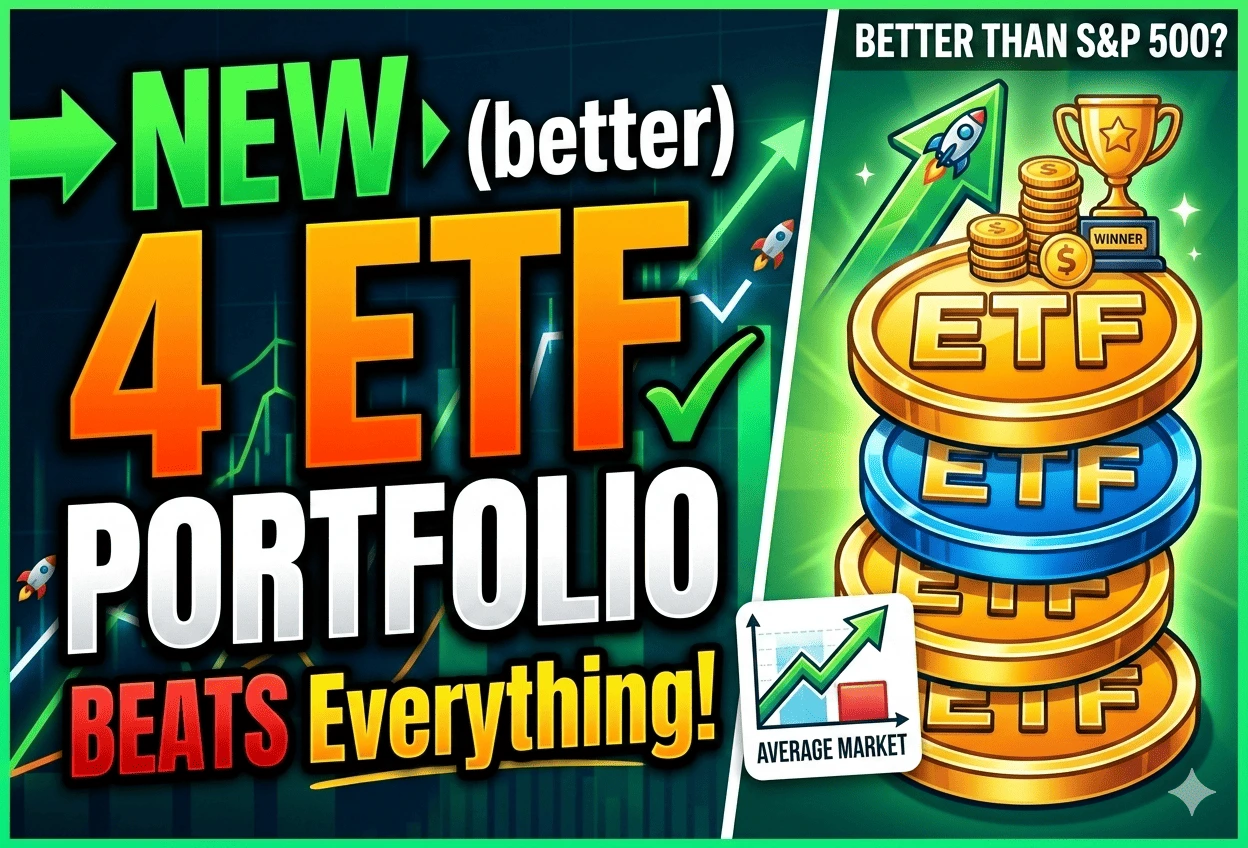
NEW (Better) 4 ETF Portfolio, listen up, students. If you watch just one investing video—or read one guide—this year, make it this one. I’m Nolan Goa, but my students call me Professor G, and I built “Investing Simplified” to cut through the Wall Street noise. Right now, 99% of investors are overcomplicating their lives with expensive advisors and outdated models. I’m going to show you a “set and forget” strategy that takes five minutes to set up and has been systematically beating the market for a decade. We are moving away from “geographical” investing and into a high-octane, evidence-based strategy built for the 2026 market pivot.
Key Thesis: This 4-ETF combination is engineered to maximize asymmetric upside through AI dominance and price momentum while utilizing recession-proof value stocks to provide a structural floor against volatility.
The “Old Guard” Exit: Why Bonds and International Stocks are Out
To achieve market-beating returns, we must first prune the “dead wood” from your portfolio. Traditional diversification is failing because it ignores modern market dynamics.
The Case Against Bonds
Bonds were once the “safe haven” of the balanced portfolio. Today, they are “weak sauce.”
- Failed Protection: Over the last five years, bond ETFs have returned -5%. They didn’t protect capital; they eroded it.
- National Debt Crisis: With U.S. national debt reaching unprecedented levels, even foreign sovereign funds are hesitant to buy our debt.
- The Replacement: In this 4-ETF model, we replace the “safety” of bonds with the downside protection of SCHD and the defensive rebalancing of SPMO, allowing for safety without sacrificing all your upside.
The Case Against International ETFs (VXUS)
Many advisors still push international diversification (VXUS), but they are stuck in 1980.
- Market Share vs. Geography: Thanks to globalization, geography is irrelevant. You don’t need a German ETF to profit from Germans; you just need to own Microsoft or Starbucks. The largest companies in the world only reach that status by dominating every global region.
- The Growth Gap: Since inception, VXUS has averaged roughly 5% annual growth. Even in 2025—a “skyrocket” year where international stocks actually beat the S&P 500—the long-term average remained stuck in the single digits. Every ETF in my 4-fund strategy has doubled that performance over the last 10 years.
NEW (Better) 4 ETF Portfolio
The Foundation: SPYM (or VOO) – The S&P 500 Anchor
Every empire needs a bedrock. The S&P 500 is the ultimate “survival of the fittest” mechanism. It tracks the 500 largest companies in the U.S., automatically adding rising stars and kicking out the laggards. Whether you use VOO or SPYM, you are essentially betting on the collective ingenuity of the American economy.
| Metric | SPYM / VOO Data (Source) |
| Average Annual Appreciation | ~11% (Since Inception) |
| Strategy | Broad Market Exposure / Self-Cleansing Index |
| Top Holdings | Nvidia, Apple, Microsoft, Berkshire Hathaway |
——————————————————————————–
The Growth Engine: QQQM (or SCHG) – AI and Tech Dominance
If you want the portfolio to skyrocket, you need exposure to the sectors defining the next decade: AI and Technology. While many investors buy the famous QQQ, the “Simplified” approach favors QQQM.
- Cost Advantage: QQQM tracks the exact same Nasdaq 100 index as QQQ but with a lower expense ratio (0.15% vs. 0.20%).
- Sector Dominance: It is heavily weighted toward tech and consumer discretionary, providing the high-reward upside required to build real wealth.
- Explosive Performance: QQQM has delivered an average yearly appreciation of 19% over the last 10 years.
NEW (Better) 4 ETF Portfolio
The Shield: SCHD – The Value and Dividend Protector
High-growth tech can be volatile. SCHD (Schwab US Dividend Equity ETF) is your recession-proof stabilizer. It focuses on high-quality value stocks that pay you to wait.
- The Value Cycle: Markets move in cycles. When tech valuations become unsustainable, capital rotates into the boring, cash-flow-heavy companies found in SCHD.
- The 2026 Pivot: This is the “Perfect Storm.” There are currently trillions of dollars sitting in high-yield savings accounts earning 4-5%. As the Federal Reserve cuts rates and a new Fed Chair takes over in mid-2026, those savings rates will plummet. That money will flee to the next safest asset class with cash flow: dividend-paying value stocks like SCHD.
NEW (Better) 4 ETF Portfolio
The Unicorn: SPMO – S&P 500 Momentum
SPMO is the secret sauce. It selects the 100 companies within the S&P 500 that have the highest price trajectory over the last 12 months. It rebalances semi-annually, ensuring you are always riding the “hot hand” of the market.
Performance in Crisis: The 2022 Proof of Concept
| ETF Ticker | 2022 Performance (Market Crash) |
| QQQM (Tech Growth) | -32% |
| VOO / SPYM (Market Avg) | -18% |
| SPMO (Momentum) | -10% |
SPMO provides the growth of tech funds but the buffer of value funds. It is a “unicorn” that stays current with the market’s strongest trends.
NEW (Better) 4 ETF Portfolio
The Titans: 10 Companies Dominating the 4-ETF Sector
These ten companies are the heavy lifters across your four ETFs. Their dominance is why this strategy works.
- Nvidia: The undisputed king of AI hardware and the “brains” of the modern data center.
- Growth Potential: Total dominance of the semiconductor AI infrastructure boom.
- Apple: A consumer hardware fortress with a services ecosystem that generates massive recurring revenue.
- Growth Potential: Continued global expansion of its high-margin services division.
- Microsoft: The essential enterprise partner, leading the way in cloud computing and AI software integration.
- Growth Potential: Ubiquity in global business operations and Azure cloud growth.
- Google (Alphabet): A virtual monopoly on global search and digital advertising.
- Growth Potential: Integration of generative AI into its core search and YouTube products.
- Amazon: The dual-engine giant of global e-commerce and the AWS cloud platform.
- Growth Potential: Margin expansion as AWS continues to scale global AI workloads.
- Meta: The social infrastructure of the world, pivoting heavily into AI-driven advertising.
- Growth Potential: Massive user data advantage in training and deploying consumer AI.
- Broadcom: The critical provider of semiconductor and infrastructure software for networking.
- Growth Potential: Indispensable supplier for the world’s growing AI data centers.
- Berkshire Hathaway: Warren Buffett’s conglomerate, providing massive stability through diverse industrial and insurance holdings.
- Growth Potential: Unmatched cash reserves to capitalize on market downturns.
- JPMorgan Chase: The world’s leading financial institution with a fortress balance sheet.
- Growth Potential: Capturing market share as smaller regional banks struggle in a high-rate environment.
- Costco: A recession-proof retail powerhouse with an incredibly loyal, membership-based model.
- Growth Potential: Consistent expansion and stable performance regardless of the economic climate.
NEW (Better) 4 ETF Portfolio
Macro Analysis: The 2026 Market Pivot
The year 2026 will be defined by a massive Capital Rotation. We are preparing for two specific pillars:
- The AI Hype Correction: Tech valuations are currently skyrocketing at a pace that could lead to a dip. By holding SCHD and SPMO, your portfolio has built-in hedges. If tech drops, SPMO’s semi-annual rebalancing will pivot you into the next winning sector, while SCHD provides the dividend floor.
- The Interest Rate Shift: The mid-2026 Fed Chair change will likely solidify a low-rate environment. When those trillions of dollars currently “parked” on the sidelines in money markets finally move, they will flood into equities, specifically targeting the high-quality names found in our 4-ETF model.
NEW (Better) 4 ETF Portfolio
The Implementation: 3 Model Portfolios
Your allocation should reflect your timeline. Note that for those in retirement, we also consider tax and RMD nuances.
The Aggressive Builder (Far from Retirement)
- Goal: Maximum wealth accumulation through momentum and tech.
- Allocation: 30% SPYM, 25% SPMO, 25% QQQM, 20% SCHD.
- Safety Net: 3–6 months of living expenses in an emergency fund.
The Balanced Protector (10 Years to Retirement)
- Goal: Capture the 2026 pivot while mitigating late-stage volatility.
- Allocation: 25% SPYM, 25% SPMO, 20% QQQM, 30% SCHD.
- Safety Net: 1 year of living expenses in cash.
The Wealth Preserver (In Retirement)
- Goal: Preservation of capital and consistent income.
- Allocation: 50% SCHD, 25% SPYM, 15% SPMO, 10% QQQM.
- Safety Net: 3 years of living expenses in cash.
- Expert Note: Depending on your specific RMD (Required Minimum Distribution) needs and tax bracket, this model may also incorporate short-term treasuries or bonds to simplify withdrawals.
Investor FAQ
Why is a 4-ETF portfolio better than a total market fund?
A total market fund includes thousands of “zombie” companies. This 4-ETF strategy filters for quality, momentum, and high-growth tech, resulting in historically higher returns.
What is the difference between QQQ and QQQM?
They are identical in holdings, but QQQM is the “mini” version with a lower expense ratio (0.15%), saving you money every year.
Why should I stop buying international stocks (VXUS) in 2026?
Because the U.S. “Titans” are already international. VXUS has averaged 5% growth; my 4-ETF funds have doubled that. Don’t diversify into underperformance.
How does SPMO protect me during a market crash?
By rebalancing every six months, SPMO exits stocks that are losing steam and moves into defensive winners. In 2022, it only dropped 10% while tech dropped 32%.
Is SCHD still a good investment after lagging behind tech?
Absolutely. You want to buy the “deals” before the rotation happens. 2026 rate cuts will make SCHD the primary target for trillions of dollars in sideline capital.
What happens to my investments when the Fed cuts rates?
Generally, stock valuations rise as borrowing costs fall. Specifically, dividend-paying ETFs become much more attractive to income-seekers.
Do I need a financial advisor to manage this portfolio?
No. This is “Investing Simplified.” You can manage this yourself in five minutes a month.
Why are bonds considered “weak sauce” in this strategy?
Bonds have lost 5% over the last five years and failed to provide safety during the 2022 crash. We use SCHD and SPMO for protection instead.
How often does the Momentum ETF (SPMO) rebalance?
It rebalances semi-annually (every six months) to ensure it stays current with the market’s strongest performers.
How much cash should I keep outside of my 4-ETF portfolio?
I recommend anywhere from 3 months to 3 years of living expenses depending on your proximity to retirement.
Conclusion: Your Path to Financial Empowerment
Investing is only as complicated as you allow it to be. By anchoring your wealth in the S&P 500, fueling it with tech growth, protecting it with value, and optimizing it with momentum, you are positioning yourself to beat 99% of other investors.
Remember, while this strategy is evidence-based and high-performing, all investing carries risk. Do your due diligence and stay disciplined.
Next Steps: If you want a tailored strategy specifically for your goals and risk profile, I am now taking applications for a limited number of Zoom consultations. Click the link in the description or pinned comment to apply. Let’s get your finances straight and keep your investing simplified.