
VOO vs. VTI: The Definitive 2026 Investment Guide to Vanguard’s Core ETFs

VOO vs. VTI, this document is for educational and informational purposes only and does not constitute financial, investment, tax, or legal advice. The information provided herein is synthesized from specific market analyses and historical data which may not be applicable to your individual financial situation. Investing in exchange-traded funds (ETFs) and the stock market involves significant risk, including the potential loss of principal. Past performance is not indicative of future results. It is strongly recommended that you consult with a qualified financial professional or investment advisor before making any financial decisions or implementing any investment strategy. Your capital is at risk, and the author of this report assumes no liability for any investment losses incurred. VOO vs. VTI INTRODUCTION: THE $280,000 DECIMAL POINT In the high-stakes arena of institutional asset management, many retail investors treat the choice between the S&P 500 and the Total Stock Market as a negligible “toss-up.” However, as we enter the 2026 fiscal landscape, a granular analysis reveals that even a minor divergence in annualized returns can fundamentally alter an investor’s terminal wealth and legacy. The Hook Consider an investor who, in 2015, allocated $10,000 to the broader market. A decade later, that capital would have yielded two distinct outcomes: At a glance, the 0.56% performance gap appears statistically insignificant. Yet, for the disciplined investor contributing 500 monthly over a 40-year horizon**, this “negligible” edge compounds into a staggering **280,000 difference in the final portfolio balance. This is the “Decimal Point Trap”—the failure to recognize that minute tracking errors and style drifts are the architects of retirement deficits. That $280,000 represents the difference between a standard retirement and the ability to purchase a primary residence outright or fully endow a multi-generational college fund. Defining the Contenders VOO vs. VTI MACRO ANALYSIS: THE DOMINANCE OF THE MEGA-CAP ERA To evaluate the 2026 outlook for these ETFs, one must synthesize the macroeconomic cycles of the last quarter-century. Performance is not a vacuum; it is a reflection of monetary policy, technological disruption, and institutional capital flows. The “Lost Decade” (2000–2009): Small-Cap Resilience The 2000s are famously categorized as the “Lost Decade” for large-cap equities. Following the implosion of the dot-com bubble and the catastrophic 2008 Financial Crisis, the S&P 500 remained essentially flat for ten years. During this period of large-cap stagnation, the broader market provided a vital volatility cushion. Small and mid-cap companies, often less sensitive to the global institutional deleveraging seen in the “Titans,” quietly outperformed. Investors in VTI benefitted from this broader net, as the “Total Market” approach mitigated the idiosyncratic risks of a top-heavy, large-cap-only strategy. The “Golden Age” of Mega-Caps (2020s): AI and the Monopoly Moat Contrast the 2000s with the current “Golden Age” of the 2020s. We have transitioned into an era of unprecedented concentration. Driven by massive AI disruption and the consolidation of digital infrastructure, the “Big Four” (Apple, Microsoft, Alphabet, Amazon) have pulled the index to historic heights. In this environment, VOO has frequently outpaced VTI. Because both funds utilize Market Capitalization Weighting, the success of these titans is self-reinforcing. As Apple or Microsoft increases in value, they occupy a larger percentage of the fund, forcing the index to buy more of the “winners.” While VTI includes 3,100 more companies than VOO, the 87% overlap between the two ensures that the giants dictate the narrative. The inclusion of small-caps in VTI has, in recent years, acted as a “drag” rather than a “cushion,” as smaller companies struggled with the cost of capital in a higher-interest-rate environment compared to the cash-rich balance sheets of the S&P 500. The Strategic Implication of the 87% Overlap The extreme overlap highlights a “diminishing marginal utility” in holding both funds. For most investors, owning both VOO and VTI is redundant; it is essentially a double-down on the same mega-cap tech thesis. The decision for 2026 rests on whether you believe the “Golden Age” of concentration will persist or if a “mean reversion” will favor the broader, small-cap-inclusive net of VTI. VOO vs. VTI What are the main differences in composition between VOO and VTI? The historical performance between VOO (Vanguard S&P 500 ETF) and VTI (Vanguard Total Stock Market ETF) shows subtle variations, but these can result in significant differences over decades. Here are the main points on how the performance of these two funds varies:Comparison of Recent ReturnsAnnualized Return: In a scenario starting in 2015, VOO slightly outperformed VTI, with an annualized return of 13.32% versus 12.76% for VTI. Capital Growth: An initial investment of US$10,000 in 2015 would have grown to approximately US$38,000 in VOO*, while in VTI the value would be around US$36,000. Long-Term Impact: Although the annual difference of 0.56% seems small, in a 40-year investment plan with monthly contributions, this variation could result in a difference of almost US$280,000 at retirement. Performance in Different Market CyclesThe variation between funds occurs mainly due to the composition of their portfolios and the economic climate:2000s (“The Lost Decade”): During this period, the S&P 500 (VOO) remained practically stable due to crises such as the dot-com bubble and the 2008 financial crisis. In this scenario, small companies outperformed large ones, which gave VTI a competitive advantage and a greater “cushion” of protection due to its greater diversification. 2020s: This period has been favorable for mega-caps (titans like Apple, Microsoft, and Amazon). Since VOO focuses exclusively on the 500 largest companies, it has directly benefited from the dominance of these giants, outperforming VTI, whose smaller companies have not kept pace with the same growth rate. Similarities and Influence of the GiantsDespite the differences, the two funds have an overlap of about 87%. As both use the market capitalization weighting system, the largest US companies end up dominating the performance of both ETFs. In VTI, although there are more than 3,000 small and medium-sized companies, their impact is often “drowned out” by the weight of the giants that also make up VOO. In short, VOO tends to perform better when large corporations lead the market, while
SCHD vs. VYM: The Definitive 2026 Dividend ETF Comparison and Quantitative Research Report
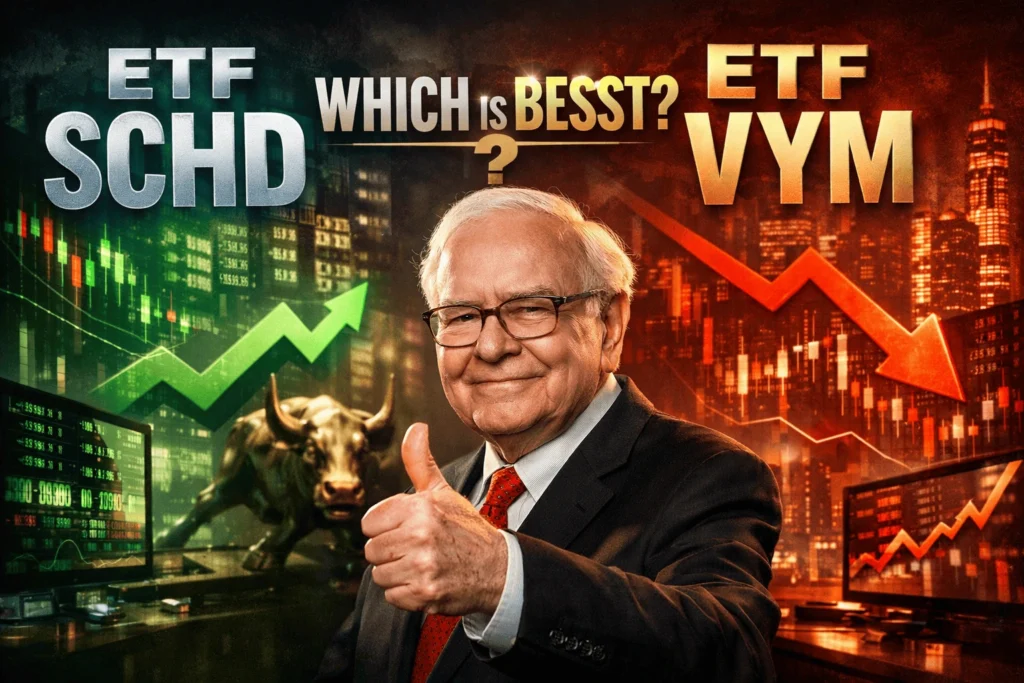
SCHD vs. VYM, Strategic Investment Notice: The following document is provided exclusively for educational and research purposes by the Senior Quantitative Research Lead. This analysis does not constitute a recommendation, solicitation, or offer to buy or sell any security, nor does it constitute certified financial, legal, or tax advice. YMYL (Your Money Your Life) Warning: Investing in equity markets involves inherent risks, including the total loss of principal. The exchange-traded funds (ETFs) discussed herein—SCHD and VYM—possess specific risk profiles related to dividend-paying equities and market volatility. Readers must consult with a certified financial professional or licensed investment advisor before implementing any strategy mentioned in this report. Historical Performance Caveat: All data points, including the specific 2026 Year-to-Date (YTD) returns of 11.91% for SCHD and 2.12% for VYM, are historical. Past performance, whether measured over 10 years or the current 2026 fiscal year, is never a guarantee of future results. Market conditions as of March 28, 2026, are subject to rapid and unforeseen shifts. SCHD vs. VYM INTRODUCTION: THE SEARCH FOR QUALITY IN A VOLATILE 2026 As we progress through the first quarter of 2026, the global investment landscape is defined by a paradoxical search for both stability and yield. With market volatility remaining a persistent hurdle, institutional and retail investors alike are re-evaluating the foundational components of their income-generating portfolios. The traditional “60/40” split has faced rigorous testing, leading to an intensified focus on high-conviction dividend strategies that can withstand macro headwinds while providing meaningful real returns. Central to this evaluation are the two preeminent titans of the dividend space: the Schwab U.S. Dividend Equity ETF (SCHD) and the Vanguard High Dividend Yield ETF (VYM). While retail narratives often conflate the two as “income proxies,” a quantitative deep-dive reveals a stark divergence in methodology, risk-adjusted performance, and factor exposure. Schwab U.S. Dividend Equity ETF (SCHD), managed by Charles Schwab, follows a rigorous, passive strategy tracking the Dow Jones U.S. Dividend 100 Index. Since its launch on October 19, 2011, SCHD has been synonymous with “Dividend Quality,” utilizing a screening process that prioritizes financial health and sustainable growth. Vanguard High Dividend Yield ETF (VYM), a stalwart of the Vanguard suite, tracks the FTSE High Dividend Yield Index. Within the context of our current data, VYM was launched on February 6, 2019, with a specific mandate to capture the higher-yielding segment of the U.S. equity market, often emphasizing sectors that provide higher current cash flows over aggressive growth. As of late March 2026, these two vehicles are exhibiting one of the most significant performance gaps in recent history, necessitating a granular analysis of their underlying risk metrics. SCHD vs. VYM MACRO ANALYSIS: QUANTITATIVE CORRELATION VS. MOMENTUM DIVERGENCE In the current market environment (Last Updated: Mar 28, 2026), the behavior of dividend equities has been shaped by a massive 0.95 correlation between SCHD and VYM. From a portfolio construction perspective, a 0.95 correlation indicates that these two assets move in near-lockstep regarding price direction. This high degree of synchronization suggests that for the average investor, holding both assets simultaneously provides negligible diversification benefit; they are effectively “doubling down” on the same systematic risk factors. However, a strategist must look beyond directionality and into the magnitude of performance. Despite the high correlation, we are witnessing a “Performance Paradox” in 2026. SCHD has achieved a 11.91% YTD return, while VYM has lagged significantly at 2.12%. The Sharpe and Sortino Framework Institutional investors utilize the Sharpe Ratio and Sortino Ratio to determine the efficiency of these returns. At first glance, this creates a quantitative puzzle: Why does the lagging fund (VYM) have a superior 1-year risk-adjusted ratio? The answer lies in the “rolling” nature of these metrics. VYM’s higher ratios reflect its stability over the trailing 12 months, whereas SCHD’s 2026 YTD surge has introduced “upward volatility” which, while profitable, can mathematically suppress a traditional Sharpe Ratio. For the 2026 investor, SCHD represents the “Momentum and Quality” play, while VYM remains the “Low-Volatility Efficiency” play. SCHD vs. VYM CASE STUDY: SCHD – THE QUALITY FACTOR LEAD SCHD is the primary vehicle for investors seeking “Dividend Quality.” Its underlying index doesn’t just look for high yields; it looks for cash flow, return on equity, and a decade-long track record of increasing payouts. SCHD Key Quantitative Metrics (2026) Metric SCHD Value Strategic Significance Trailing Twelve Month (TTM) Yield 3.47% Superior income generation in current macro environment. Expense Ratio 0.06% Highly competitive cost structure for institutional core. YTD Return (2026) 11.91% Significant alpha generation over the broad dividend market. 10-Year Annualized Return 12.27% Demonstrated long-term compounding capability. Max Drawdown (Inception) -33.37% Stronger tail-risk mitigation compared to high-yield peers. Sharpe Ratio (1Y) 0.89 Efficient return profile relative to price swings. Volatility (1M) 2.49% Represents a 2026 “flight to quality” with lower fluctuations. Quantitative Verdict: With an Overall Rank of 52 and a Sortino Ratio Rank of 57, SCHD is currently outperforming VYM in growth-oriented dividend categories. Its 2.49% one-month volatility makes it the premier choice for investors prioritizing capital preservation during the current 2026 market fluctuations. SCHD vs. VYM CASE STUDY: VYM – THE LOW-COST EFFICIENCY MODEL While VYM is often categorized as the “High Yield” alternative, the 2026 data reveals a nuance: its TTM yield of 2.41% is currently trailing SCHD. VYM’s value proposition in 2026 has shifted toward expense management and mean-reversion efficiency. VYM Key Quantitative Metrics (2026) Metric VYM Value Strategic Significance Trailing Twelve Month (TTM) Yield 2.41% Currently trailing the growth-quality leader. Expense Ratio 0.04% The industry floor for dividend fund costs. YTD Return (2026) 2.12% Conservative performance in a growth-led environment. 10-Year Annualized Return 11.12% Stable long-term returns, though trailing SCHD. Max Drawdown (Inception) -56.98% Higher historical tail-risk exposure. Martin Ratio (1Y) 6.21 High efficiency relative to average drawdown periods. Sharpe Ratio (1Y) 1.06 Superior risk-adjusted efficiency over a 12-month lookback. Quantitative Verdict: Despite its lower YTD return, VYM holds an Overall Rank of 67, suggesting that its recent performance has been achieved with extremely low risk. VYM is the ideal candidate for the